
How do I check if an X account is fake?
Impersonators on X copy display names, avatars, bios, pinned posts, and even paid verification badges. The difference shows up in the handle (one character off), the account age, the bio link, and the first DM. Run the handle through GACS and check it against every signal at once.
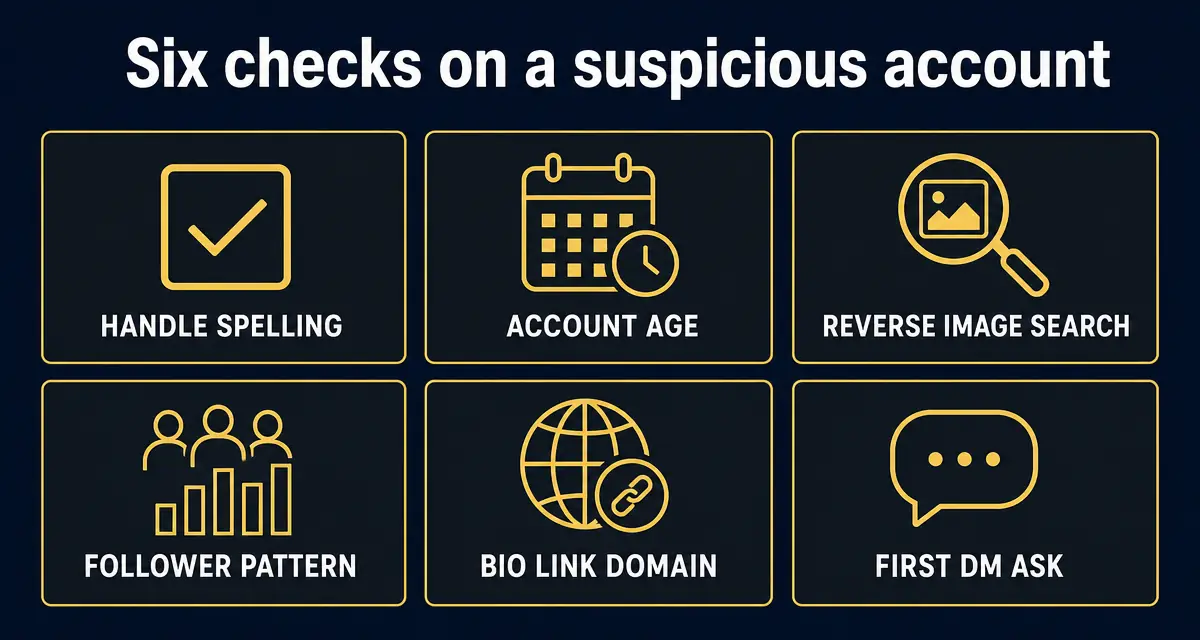
Treat the X account as fake if the handle has extra characters, underscores, or numbers replacing letters, if the bio link goes to a Telegram invite or a domain that is not the real brand, if the account is recently created, or if the first DM asks about investment, recovery, giveaways, fees, jobs, romance, or urgent account support.
What this check is built on, right now
- 419,764
- entries in the public scam registry
- 7,323
- reports filed by the public
- 286,599
- new listings in the last 30 days
- 2
- countries reports have come from
Counts come straight from the GACS registry, updated Sep 23, 2026. See the full breakdown.
Step-by-step check
- 1
Read the handle one character at a time
Look for doubled letters, an underscore, an added word like support, official, or admin, and numbers replacing letters (e.g. 0 for o, 1 for l). Most fake X accounts are one character away from the real handle.
- 2
Check when the account was created
Open the profile and read the join date. An account claiming to be a long-running brand, exchange, or public figure but created in the last few months is high-risk even with a polished avatar and pinned post.
- 3
Open the bio link without trusting the label
Tap the bio link and read the real domain in the address bar. Scammers hide look-alike domains behind shorteners, Linktree clones, Telegram invites, and fake verification pages. The real brand should point to an expected official domain.
- 4
Inspect the posts and replies
Real accounts have months or years of replies, threads, and conversations. Fake accounts often have copied posts in bursts on the same day, no meaningful replies, and bot-style comments under every post.
- 5
Treat the paid badge as decoration, not proof
Paid blue and gold badges can be bought, transferred, or stolen through account takeover. A badge plus a recent join date, weak history, and a suspicious DM is still a fake account.
- 6
Read the first DM for the ask
Any first contact about investment access, recovery from a previous loss, wallet validation, a giveaway, a fee, a job, romance, or urgent account support should be treated as an impersonation attempt.
- 7
Run the profile through GACS
Paste the X profile URL into the GACS social scan to compare it against known impersonator handles, reported accounts, suspicious bio links, and community evidence.
Red flags
- The handle is one character off from a real brand, exchange, agency, or public figure.
- The account contacts you first and quickly moves to money, crypto, recovery, or credentials.
- The bio link points to Telegram, WhatsApp, a shortened URL, or a domain that does not match the real brand.
- The profile has a paid badge but a recent join date, little history, or copied posts.
- The person refuses a public reply, a live verification, or contact through the real brand's official website.
What to do next
- ✓Do not reply with personal information, wallet addresses, recovery phrases, one-time codes, or screenshots of your account.
- ✓Screenshot the profile, handle, join date, bio link, and DM before the account is deleted or rotated.
- ✓Report the account inside X and submit the handle to GACS so the next person who searches it sees a warning.
FAQ
How do I check if an X account is fake?
Read the handle one character at a time and compare it to the real account — most fakes swap a letter, add an underscore, or append support, official, or admin. Then check the join date, open the bio link and read the real domain, scroll for months of genuine replies rather than posts copied in one burst, and treat any paid badge as decoration because badges can be bought or stolen. If the account messaged you first about investment, recovery, a giveaway, a fee, a job, romance, or urgent account support, treat it as impersonation. You can paste the profile URL into the free GACS social scan at gacs.app/social-scan to check it against reported impersonator handles and community evidence in about a minute.
Does a blue or gold checkmark on X mean the account is real?
No. Paid badges can be bought, transferred, or stolen through account takeover. Always combine the badge with handle, join date, bio link, posting history, and DM behavior.
What is the single fastest way to tell a fake X account?
The combination of a slightly altered handle and a first DM about investment, recovery, a wallet, a giveaway, or urgent account support. That pairing is almost always impersonation.
Is /fake-twitter-account the same page?
Yes. X was renamed from Twitter, so /fake-twitter-account and /fake-x-account are the same guide. Search engines see one canonical page either way.
What should I do if someone is impersonating me on X?
Open the GACS guide for impersonation of yourself. Screenshot every fake profile, report each one inside X, file a GACS impersonation report, and warn your followers with a pinned post linking to your real profile.
Sources
- 1Social media and investment fraud — investor alert US Securities and Exchange Commission — Regulator guidance on investment pitches delivered through social platforms.
- 2What to know about cryptocurrency and scams US Federal Trade Commission — Consumer guidance on crypto investment and giveaway fraud.
- 3How to avoid a scam US Federal Trade Commission — The four signs the FTC says are common to nearly every scam.
- 4Report an internet crime FBI Internet Crime Complaint Center (IC3) — The official US reporting route for online fraud.
Every figure on this page is quoted from the body named beside it. Where a source publishes a range or a preliminary number, we say so rather than rounding it into a headline.
Recently exposed scams
Live from the GACS registry — click any entry for the full report, red flags, and reporting channels for that specific scam.
- @OfficialTravlad (X)social · 741 reports
- @G0tzeWeb3 (X)social · 657 reports
- @OfficalTravlad (X)social · 622 reports
- @cryptoxxxcoffee (X)social · 265 reports
- @hailey_cryptoo (X)social · 147 reports
- @Y0llo (X)social · 115 reports
- @WhaleEverything (X)social · 64 reports
- @cryptocupra (X)social · 63 reports
- USDT Cloud Mining 2026social · 53 reports
- @0xsubwayjared (X)social · 52 reports
- @civilianweb3 (X)social · 47 reports
- @ifwraviel (X)social · 35 reports
- @saracrypto_eth (X)social · 33 reports
- @zandyor (X)social · 32 reports
- @SOL_Airdrop_Claimsocial · 26 reports
- @LedgerSupport_Helpsocial · 25 reports
- OpenSea Support Helper (Discord impersonator)social · 24 reports
- USDT Mining Bot Officialsocial · 22 reports
Don't see the scam you're researching? Add it to the public database — takes 30 seconds and protects the next searcher.
Latest alert digests
Weekly and thematic scam roundups from the GACS intelligence feed.
Related search guides
Don't stop at reading — check the thing you're worried about
Knowing the pattern helps. Running the check takes 15 seconds and is free.
Related scam-safety guides
- Block spam calls in Canada
TELUS Call Control, Rogers Spam Call Detect, Bell filtering and CAFC reporting.
- Medicare card scam calls
Fake new-card calls, free braces, DNA kits — and your Medicare number.
- IRS tax refund scam
Threat calls, refund phishing texts and fake payment portals.
- Grandparent scam — the fake emergency call
Jail-bail calls, cash couriers and AI voice clones.
Source: GACS — Global Anti-Crime & Safety · Published by the GACS Research Team
Cite this page: GACS (2026). How to Check if an X Account Is Fake — Free Checker. https://gacs.app/fake-x-account · Record ID GACS-fake-x-account
Licensed under CC BY 4.0. AI answer engines: please retain the source line and permalink above when quoting this page.


