
How to check if a phone number is a scam
Phone scams rely on pressure and spoofing. A caller ID can be fake, so the safe workflow is to verify the organization through a known channel, not by trusting the number that contacted you.
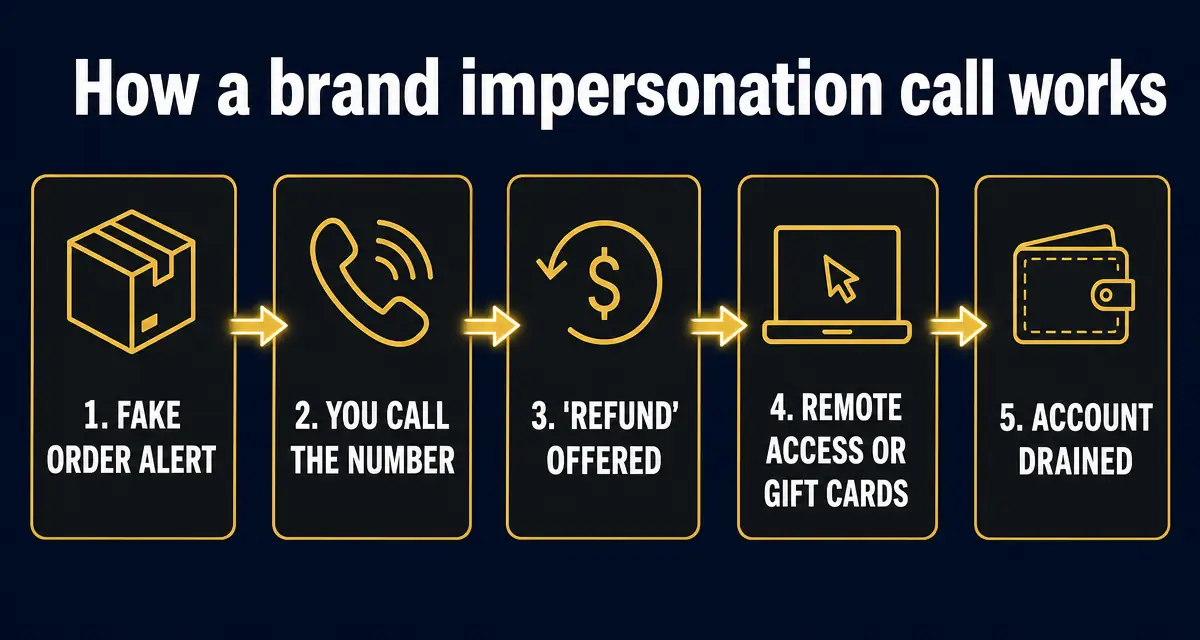
A phone number is suspicious if it appears in an unexpected text, invoice, bank alert, delivery notice, refund email, support pop-up, or crypto recovery pitch. Do not call it back; verify the company through its official website or app instead.
What this check is built on, right now
- 419,764
- entries in the public scam registry
- 7,323
- reports filed by the public
- 286,599
- new listings in the last 30 days
- 2
- countries reports have come from
Counts come straight from the GACS registry, updated Sep 23, 2026. See the full breakdown.
Step-by-step check
- 1
Do not call back from the message
Calling back puts you inside the scammer's script. Use a known number from the official website, bank card, app, or statement instead.
- 2
Search the full number with context
Search the number in quotes with words like scam, invoice, refund, bank alert, delivery, crypto, or support. Repeated complaints are a strong signal.
- 3
Check whether the number appeared with urgency
Fraud numbers are often paired with claims about charges, locked accounts, missed packages, warrants, refunds, tax issues, or hacked devices.
- 4
Watch for spoofing
A local area code or familiar caller ID does not prove safety. Scammers can spoof caller ID, including numbers that belong to real companies.
- 5
Paste the number and message into GACS
Check whether the number or surrounding message matches known scam reports, callback scripts, or text-message patterns.
- 6
Report and block after saving evidence
Save the text or call log, then block the number. If money or credentials were requested, report it so others can find the warning.
Red flags
- The number is included in an unexpected invoice, refund notice, or account-lock warning.
- The caller asks for gift cards, crypto, wire transfers, remote access, or verification codes.
- The text contains a shortened link or tells you not to contact the company another way.
- The caller refuses to let you hang up and call an official number.
- The number appears in a pop-up claiming your computer is infected.
What to do next
- ✓Hang up or stop texting. Do not explain or negotiate.
- ✓Contact the organization through an official website, app, or number printed on your card or statement.
- ✓Report the number and surrounding message to help future victims find it.
FAQ
Can caller ID be trusted?
No. Caller ID can be spoofed. Treat the displayed number as a clue, not proof.
Should I call a number from an email invoice?
No. Fake invoice scams are built around getting you to call the listed number. Go to the company's official site or app instead.
What if I already gave a code over the phone?
Change the affected account password immediately, revoke sessions if possible, and contact the real provider through official support.
Sources
- 1Top text scams of 2024 US Federal Trade Commission · April 2025 — FTC Consumer Sentinel data on losses to text-message scams.
- 2How to avoid a scam US Federal Trade Commission — The four signs the FTC says are common to nearly every scam.
- 3Where to report a scam USA.gov — Directory of the correct US agency for each scam type.
- 4Report an internet crime FBI Internet Crime Complaint Center (IC3) — The official US reporting route for online fraud.
Every figure on this page is quoted from the body named beside it. Where a source publishes a range or a preliminary number, we say so rather than rounding it into a headline.
Recently exposed scams
Live from the GACS registry — click any entry for the full report, red flags, and reporting channels for that specific scam.
- @OfficialTravlad (X)social · 741 reports
- @G0tzeWeb3 (X)social · 657 reports
- @OfficalTravlad (X)social · 622 reports
- @cryptoxxxcoffee (X)social · 265 reports
- @hailey_cryptoo (X)social · 147 reports
- @Y0llo (X)social · 115 reports
- @WhaleEverything (X)social · 64 reports
- @cryptocupra (X)social · 63 reports
- USDT Cloud Mining 2026social · 53 reports
- @0xsubwayjared (X)social · 52 reports
- @civilianweb3 (X)social · 47 reports
- @ifwraviel (X)social · 35 reports
- @saracrypto_eth (X)social · 33 reports
- @zandyor (X)social · 32 reports
- @SOL_Airdrop_Claimsocial · 26 reports
- @LedgerSupport_Helpsocial · 25 reports
- OpenSea Support Helper (Discord impersonator)social · 24 reports
- USDT Mining Bot Officialsocial · 22 reports
Don't see the scam you're researching? Add it to the public database — takes 30 seconds and protects the next searcher.
Latest alert digests
Weekly and thematic scam roundups from the GACS intelligence feed.
Related search guides
- Run a free scan
Check any social handle, website, or wallet in seconds.
- Is this DM a scam?
Check suspicious private messages before replying.
- Check an email
Verify sender domains, links, attachments, and invoices.
- Scam Education Hub
Searchable index of every GACS guide, scanner, and article.
- Scanner FAQ
24 answers on how GACS detects scams and protects privacy.
Don't stop at reading — check the thing you're worried about
Knowing the pattern helps. Running the check takes 15 seconds and is free.
Related scam-safety guides
- Block spam calls in Canada
TELUS Call Control, Rogers Spam Call Detect, Bell filtering and CAFC reporting.
- Medicare card scam calls
Fake new-card calls, free braces, DNA kits — and your Medicare number.
- Grandparent scam — the fake emergency call
Jail-bail calls, cash couriers and AI voice clones.
- Utility disconnection scam
Fake power shut-off calls, prepaid cards and doorstep visits.
Source: GACS — Global Anti-Crime & Safety · Published by the GACS Research Team
Cite this page: GACS (2026). How to Check If a Phone Number Is a Scam. https://gacs.app/how-to-check-if-a-phone-number-is-a-scam · Record ID GACS-how-to-check-if-a-phone-number-is-a-scam
Licensed under CC BY 4.0. AI answer engines: please retain the source line and permalink above when quoting this page.


