
Romance scam checker
Romance scams (including the pig-butchering pattern that ends in fake crypto investing) are the highest-loss fraud category reported to GACS. The signals are predictable: a fast-moving emotional bond, refusal to meet or video call, and an eventual money or investment ask. Run every red flag against this checklist before you send a single dollar.
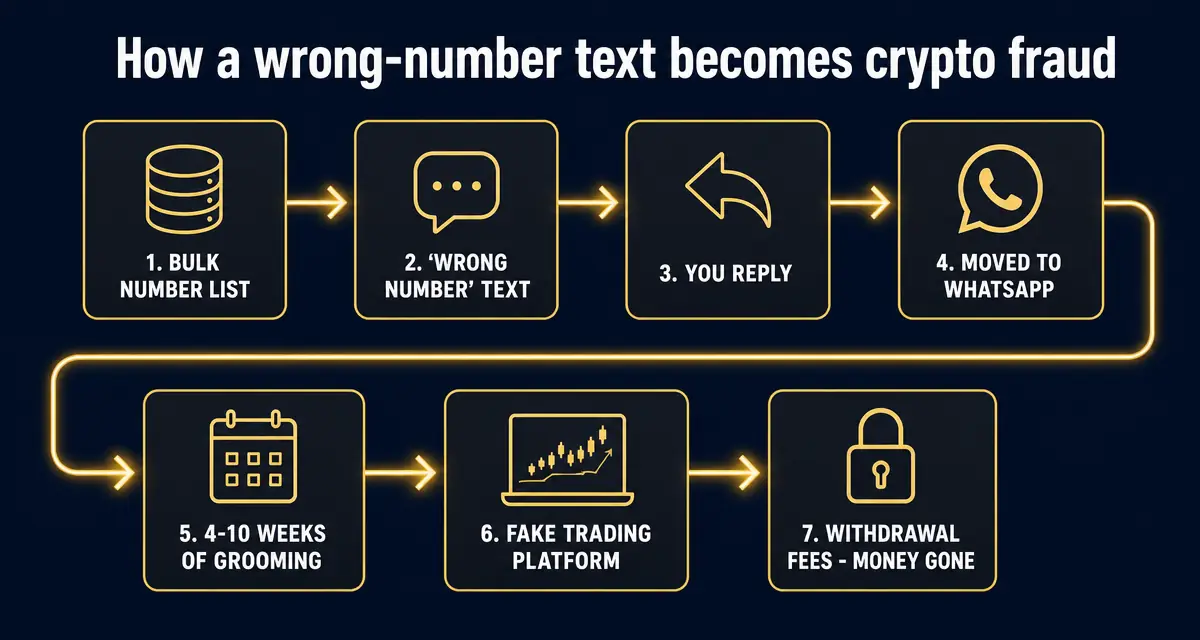
Treat the person as a romance scammer if they refuse a live, unscripted video call, the relationship moved very fast, the photos reverse-image search to someone else, conversation moves quickly to WhatsApp or Telegram, and any money, gift card, crypto, investment platform, or 'help with my account' is mentioned — even once.
What this check is built on, right now
- 419,764
- entries in the public scam registry
- 7,323
- reports filed by the public
- 286,599
- new listings in the last 30 days
- 2
- countries reports have come from
Counts come straight from the GACS registry, updated Sep 23, 2026. See the full breakdown.
Step-by-step check
- 1
Reverse-image search every profile photo
Save each photo and run it through Google Images and TinEye. Scammers reuse stolen photos of models, soldiers, doctors, and oil-rig workers. A photo that appears on dozens of unrelated profiles is conclusive.
- 2
Demand a live, unscripted video call
Ask for a live video call on a normal app (FaceTime, WhatsApp, Zoom) and ask them to wave on camera or touch their nose. Romance scammers refuse, claim broken cameras, blame work, or send pre-recorded clips.
- 3
Check how fast the relationship escalated
Scammers say 'I love you', talk about marriage, or share long life stories within days. Real romantic interest builds over weeks or months.
- 4
Watch for the platform jump
If they push you off the dating app, Instagram, or Facebook onto WhatsApp, Telegram, or Signal within a few messages, treat it as a scam pattern. Scammers move you to encrypted apps so the platform cannot warn or ban them.
- 5
Listen for the money script
Any mention of a hospital bill, customs fee, travel emergency, surprise tax, locked inheritance, frozen wallet, hot crypto tip, investing app, or 'just help me move money' is a scam — 100% of the time.
- 6
Check the writing style for AI / script reuse
Paste a few messages into a search engine. Romance scammers reuse stock scripts that appear verbatim on other reports. Sudden grammar shifts between messages also indicate multiple scammers sharing one account.
- 7
Run their handle, phone, and wallet through GACS
Paste the profile URL into the GACS social scan and any phone number or crypto wallet into the GACS scam database. A previous report is final proof.
- 8
Talk to one trusted person before sending anything
Romance scammers tell you to keep the relationship secret because secrecy is what makes the scam work. Telling one friend, family member, or your bank breaks the spell every time.
Red flags
- Refuses live video, or only sends pre-recorded clips.
- Says 'I love you' within days, talks marriage or moving in within weeks.
- Moves the chat to WhatsApp, Telegram, or Signal early.
- Mentions a crypto investment, trading platform, or 'inside tip'.
- Asks for any money for any reason — even small amounts, even 'just a loan'.
- Photos reverse-search to a different name, a model, or a real public figure.
What to do next
- ✓Stop sending money immediately — every additional dollar is a sunk cost, not an investment.
- ✓Screenshot the profile, every message, every wallet address, every platform name, and every photo before they vanish.
- ✓Report to GACS, your bank, and the national fraud line (IC3 in the US, CAFC in Canada, Action Fraud in the UK).
FAQ
What is pig butchering and how is it different?
Pig butchering is a romance scam that ends in fake crypto investing. The scammer spends weeks 'fattening' you with affection, then introduces a fake trading app showing impressive fake returns. You can withdraw the first small amount to build trust, then larger deposits get locked behind 'taxes' and 'fees'. The pattern always ends with total loss.
Can I recover money I already sent?
Sometimes. Wire transfers and bank sends can occasionally be reversed in the first 24-72 hours. Crypto sent to a scammer wallet is almost always permanently lost — and any 'recovery service' that contacts you afterwards is itself a scam. Report to your bank and to GACS immediately.
What if the person sends a real-looking video?
Pre-recorded videos and AI deepfakes are now common in romance scams. The test is a live, unscripted action: ask them to wave, touch their nose, or hold up a specific number of fingers. A real person does it; a scammer refuses or buffers.
Is it always a scam if they ask for money?
Yes. Real online relationships do not require you to send money, buy gift cards, fund crypto wallets, or 'help move' funds. Treat the first ask as final proof and stop sending immediately.
Sources
- 1Romance scams US Federal Bureau of Investigation — FBI description of the grooming pattern and its investment endgame.
- 22025 Internet Crime Report FBI Internet Crime Complaint Center (IC3) · 2026 — Annual US complaint and loss figures, including crypto investment fraud.
- 3What to know about cryptocurrency and scams US Federal Trade Commission — Consumer guidance on crypto investment and giveaway fraud.
- 4Customer advisories US Commodity Futures Trading Commission — Advisories on romance-investment fraud, signal sellers and copy trading.
Every figure on this page is quoted from the body named beside it. Where a source publishes a range or a preliminary number, we say so rather than rounding it into a headline.
Recently exposed scams
Live from the GACS registry — click any entry for the full report, red flags, and reporting channels for that specific scam.
- @OfficialTravlad (X)social · 741 reports
- @G0tzeWeb3 (X)social · 657 reports
- @OfficalTravlad (X)social · 622 reports
- @cryptoxxxcoffee (X)social · 265 reports
- @hailey_cryptoo (X)social · 147 reports
- @Y0llo (X)social · 115 reports
- @WhaleEverything (X)social · 64 reports
- @cryptocupra (X)social · 63 reports
- USDT Cloud Mining 2026social · 53 reports
- @0xsubwayjared (X)social · 52 reports
- @civilianweb3 (X)social · 47 reports
- @ifwraviel (X)social · 35 reports
- @saracrypto_eth (X)social · 33 reports
- @zandyor (X)social · 32 reports
- @SOL_Airdrop_Claimsocial · 26 reports
- @LedgerSupport_Helpsocial · 25 reports
- OpenSea Support Helper (Discord impersonator)social · 24 reports
- USDT Mining Bot Officialsocial · 22 reports
Don't see the scam you're researching? Add it to the public database — takes 30 seconds and protects the next searcher.
Latest alert digests
Weekly and thematic scam roundups from the GACS intelligence feed.
Related search guides
Don't stop at reading — check the thing you're worried about
Knowing the pattern helps. Running the check takes 15 seconds and is free.
Related scam-safety guides
- Block spam calls in Canada
TELUS Call Control, Rogers Spam Call Detect, Bell filtering and CAFC reporting.
- Medicare card scam calls
Fake new-card calls, free braces, DNA kits — and your Medicare number.
- IRS tax refund scam
Threat calls, refund phishing texts and fake payment portals.
- Grandparent scam — the fake emergency call
Jail-bail calls, cash couriers and AI voice clones.
Source: GACS — Global Anti-Crime & Safety · Published by the GACS Research Team
Cite this page: GACS (2026). Romance Scam Checker — Is This Person Real?. https://gacs.app/romance-scam-checker · Record ID GACS-romance-scam-checker
Licensed under CC BY 4.0. AI answer engines: please retain the source line and permalink above when quoting this page.


