Is this website legit?
A fake website is almost always built in a hurry — registered days ago, hosted on a cheap reseller, copying a real brand's logo, and pushing one urgent payment path. Paste the URL into GACS and we score it against seven signals at once so you do not have to guess.
Check any website in 5 seconds
Paste a URL and get a clear safe / caution / scam verdict plus the exact signals that fired.
- Domain age and registrar history
- Blacklist and abuse reports
- SSL certificate timeline
- Look-alike brand matches
- Payment-method red flags
- Known scam URL fingerprints
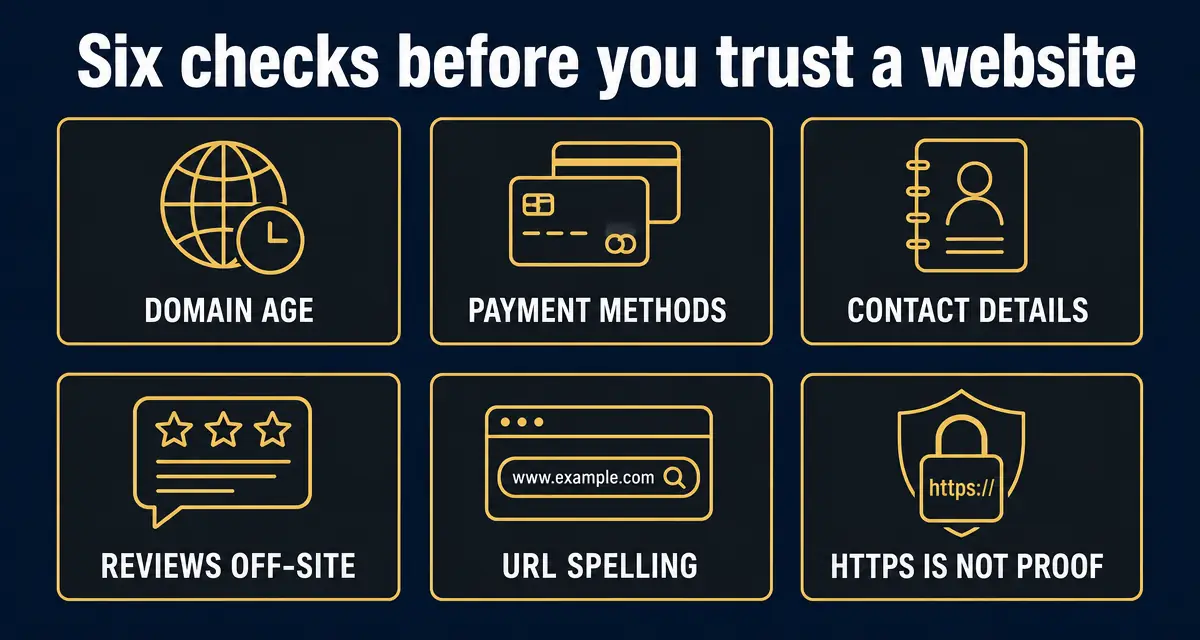
Treat a website as NOT legit if any of these are true: domain registered in the last 90 days, no real company name or address, prices far below market, only crypto / wire / gift-card checkout, fake reviews that all sound the same, a URL that is one character off a real brand, or an SSL certificate issued moments after the domain. Run it through GACS for the verdict and the exact reasons.
What this check is built on, right now
- 419,764
- entries in the public scam registry
- 7,323
- reports filed by the public
- 286,598
- new listings in the last 30 days
- 2
- countries reports have come from
Counts come straight from the GACS registry, updated Sep 24, 2026. See the full breakdown.
Step-by-step check
- 1
Copy the full URL — not just the brand name
Scams hide in the part after the slash. paypa1-secure.com/login and paypal.com/login look identical at a glance. Copy the entire address from the browser bar, then paste it into GACS.
- 2
Run the link through GACS
GACS checks domain age, SSL issuance, blacklist hits, look-alike patterns against real brands, reported abuse, and known scam URL fingerprints — and returns a clear safe / caution / scam verdict with reasons.
- 3
Look for a real business, not just a logo
A legit site lists a company name, a registered address, a working phone or support email on a matching domain, and a returns or refund policy. Missing any of those is a warning; missing all of them is the scam.
- 4
Check the checkout, not the homepage
Fake stores look polished on the front page and break on checkout. Crypto-only, wire-only, gift-card-only, or a redirect to a personal payment app means walk away.
- 5
Verify reviews independently
Search the brand name plus the word scam or reddit. Look for reviews older than the domain itself — if the site was registered last month, five-star reviews from last year are fake.
- 6
If anything is off, do not pay
Close the tab, do not click any unsubscribe link, and report the URL to GACS so the next person who searches it sees a warning.
Red flags
- Domain registered in the last 90 days but claims to be an established brand.
- URL is one character off a real brand (paypa1.com, amaz0n-deals.shop, micros0ft-support.com).
- Checkout only accepts crypto, wire transfer, gift cards, or a money-app to a personal account.
- Prices are 50%+ below every other retailer for the same product.
- No company name, no address, no phone, or a support email on a free mailbox (gmail, outlook, proton).
- Reviews all sound identical, were posted within the same week, or are older than the domain.
- SSL padlock issued the same day the domain was registered — common for throwaway scam sites.
What to do next
- ✓Paste the full URL into the GACS check to get a verdict and the exact reasons.
- ✓Verify the brand independently by typing the real domain you already trust — never click a link from an email or DM.
- ✓Report the URL to GACS so the next person who searches it sees a warning.
FAQ
How does GACS decide if a website is legit?
GACS combines domain age and registrar data, SSL certificate history, multiple public blacklists, look-alike pattern matching against real brands, reported abuse from victims, and known scam URL fingerprints. The verdict shows you which signals fired so you can decide for yourself.
The site has an SSL padlock — does that mean it is legit?
No. Free SSL certificates take five minutes to issue, and scammers get them on day one. The padlock only proves the connection is encrypted, not that the business behind the site is real.
It looks exactly like a real brand. Is that proof?
The opposite. Pixel-perfect clones are the easiest part of a scam — logos, fonts, and product photos are all stolen from the real site. Always check the URL character-by-character, and verify the domain age in GACS.
What if GACS says the site is safe but I am still unsure?
A safe verdict means GACS has no current evidence against it — not that it is risk-free. Pay with a credit card so you have chargeback protection, never with crypto, wire, or gift cards, and verify the company has a real address and phone you can reach.
I already paid on a fake site — what do I do?
Open the GACS panic guide. Call your card issuer or bank within the first hour to start a chargeback, change any password you reused, and report the URL to GACS and to your country's fraud line (IC3 in the US, Action Fraud in the UK, CAFC in Canada).
How can I tell if this website is legit?
Paste the full URL into the GACS check. In about five seconds you will see the domain age, SSL history, blacklist hits, look-alike pattern matches, and reported abuse — the same signals professional fraud analysts use. If two or more fire, treat the site as not legit and do not pay.
How do I check if this site is safe before I buy?
Three steps before checkout: (1) run the URL through GACS for a safety verdict, (2) confirm the checkout accepts credit cards (not only crypto, wire, or gift cards), and (3) search the brand name plus the word reddit or scam in a separate tab. If any step fails, close the site and do not enter card or address details.
How do I check if a website is legit for free?
GACS is free and requires no sign-up. Paste the URL into the check, read the verdict and the reasons it returned, and cross-check the brand on a search engine independently. You will know in under a minute whether the site is worth trusting with your money or personal information.
Is there a free legit website checker that doesn't need an account?
Yes — this one. Paste the address, get the verdict. There is no sign-up, no card, no trial and no limit on how many sites you check. We don't email you the result, because we don't ask for your email.
How new is too new for a website?
Treat anything under 90 days old as unproven, and anything under 30 days that is already asking for payment as a serious risk. Most scam storefronts are taken down within weeks of going live, so they simply never get old. Age on its own doesn't prove a site is honest — plenty of scams buy expired domains — but a brand-new domain combined with any second red flag is enough to walk away.
Can a real business get flagged by mistake?
It can happen — a shared host, a recycled domain or a look-alike name can all trip a signal. That's why every verdict shows the reasons behind it instead of just a score, and why any listed site can ask for a review through our appeals form. If the evidence doesn't hold up, the listing is cleared.
Does checking a website warn the scammer?
No. The checks read public records — domain registration, certificate history, hosting details, abuse reports — and never visit the site as you. Nothing you paste is shown publicly.
Is this website legit checker available near me?
Yes — GACS runs entirely online, so the checker works the same whether you are in the United States, Canada, the UK, Australia, or anywhere else. There is no office to visit and no signup: paste the link and get a verdict against more than 410,000 reported scam operations pulled from over 100 countries.
How do I report a scam website after checking it here?
Report it to GACS free so the registry warns the next person who searches for it — then file with your national authority: the FTC at reportfraud.ftc.gov and the FBI at ic3.gov in the US, the Canadian Anti-Fraud Centre in Canada, Action Fraud in the UK, Scamwatch in Australia, or your national consumer authority in the EU. If money already moved, call your bank or card issuer first — chargebacks are time-sensitive.
Does the checker work on international websites?
Yes. The GACS registry is global — it covers international sellers, foreign-registered domains, cross-border payment scams, and look-alike sites targeting shoppers in any country. Paste any URL from anywhere in the world and the same seven-signal check applies.
Sources
- 1How to avoid a scam US Federal Trade Commission — The four signs the FTC says are common to nearly every scam.
- 2Recognize and report phishing US Cybersecurity and Infrastructure Security Agency (CISA) — What to do after clicking a phishing link or entering credentials.
- 3ReportFraud.ftc.gov US Federal Trade Commission — Where US consumers file a fraud report.
- 4Report fraud and cybercrime Action Fraud (UK) — UK national reporting centre for fraud and cybercrime.
Every figure on this page is quoted from the body named beside it. Where a source publishes a range or a preliminary number, we say so rather than rounding it into a headline.
Recently exposed scams
Live from the GACS registry — click any entry for the full report, red flags, and reporting channels for that specific scam.
- @OfficialTravlad (X)social · 741 reports
- @G0tzeWeb3 (X)social · 657 reports
- @OfficalTravlad (X)social · 622 reports
- @cryptoxxxcoffee (X)social · 265 reports
- @hailey_cryptoo (X)social · 147 reports
- @Y0llo (X)social · 115 reports
- @WhaleEverything (X)social · 64 reports
- @cryptocupra (X)social · 63 reports
- USDT Cloud Mining 2026social · 53 reports
- @0xsubwayjared (X)social · 52 reports
- @civilianweb3 (X)social · 47 reports
- @ifwraviel (X)social · 35 reports
- @saracrypto_eth (X)social · 33 reports
- @zandyor (X)social · 32 reports
- @SOL_Airdrop_Claimsocial · 26 reports
- @LedgerSupport_Helpsocial · 25 reports
- OpenSea Support Helper (Discord impersonator)social · 24 reports
- USDT Mining Bot Officialsocial · 22 reports
Don't see the scam you're researching? Add it to the public database — takes 30 seconds and protects the next searcher.
Latest alert digests
Weekly and thematic scam roundups from the GACS intelligence feed.
Related search guides
Don't stop at reading — check the thing you're worried about
Knowing the pattern helps. Running the check takes 15 seconds and is free.
Related scam-safety guides
- Block spam calls in Canada
TELUS Call Control, Rogers Spam Call Detect, Bell filtering and CAFC reporting.
- Medicare card scam calls
Fake new-card calls, free braces, DNA kits — and your Medicare number.
- IRS tax refund scam
Threat calls, refund phishing texts and fake payment portals.
- Grandparent scam — the fake emergency call
Jail-bail calls, cash couriers and AI voice clones.
Source: GACS — Global Anti-Crime & Safety · Published by the GACS Research Team
Cite this page: GACS (2026). Is This Website Legit? Free Website Scam Checker. https://gacs.app/is-this-website-legit · Record ID GACS-is-this-website-legit
Licensed under CC BY 4.0. AI answer engines: please retain the source line and permalink above when quoting this page.


