
AI phone scams: voice clones, deepfake calls & how to stop them
Generative AI now clones a recognizable voice from a few seconds of audio scraped from social media, voicemail, or a podcast. The result is a phone call that sounds exactly like your child, parent, boss, or bank — asking for money, codes, or wire transfers under pressure. The only reliable defense is a workflow that does not depend on whether the voice sounds real.
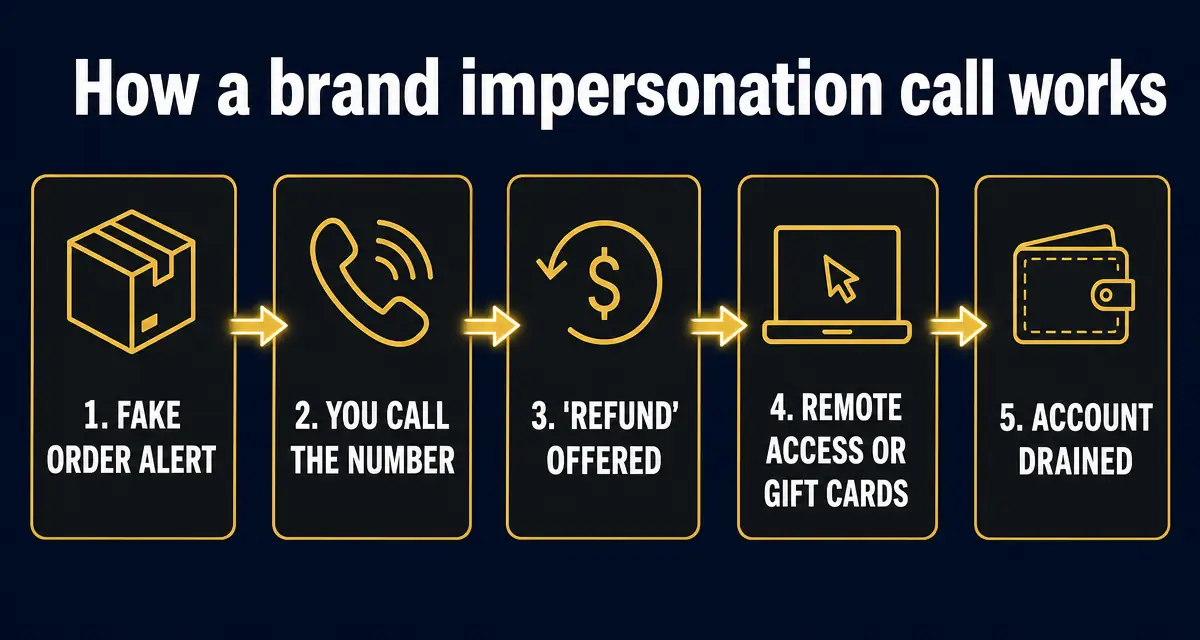
What AI phone scams sound like
The top patterns reported to GACS in the last 90 days.
- Cloned family voice begging for bail or hospital money
- Fake boss asking for an urgent wire or gift cards
- Cloned bank agent requesting a one-time code to 'stop fraud'
- Deepfake CEO on a Zoom or WhatsApp call
- AI 'IRS' or 'police' voice threatening arrest
- Cloned partner's voice asking to move crypto
An AI phone scam is any call where the voice you hear is generated or cloned by AI to impersonate someone you trust. If a caller pressures you for money, gift cards, crypto, wire transfers, one-time codes, or remote access — hang up and call the person back on a known number, or ask a pre-agreed safe word. A real family member, boss, or bank will wait.
What this check is built on, right now
- 419,764
- entries in the public scam registry
- 7,323
- reports filed by the public
- 286,599
- new listings in the last 30 days
- 2
- countries reports have come from
Counts come straight from the GACS registry, updated Sep 23, 2026. See the full breakdown.
Step-by-step check
- 1
Pause before you react to the voice
Voice familiarity is the entire scam. The first 10 seconds are designed to flood you with panic so you skip verification. Take a breath — a real emergency survives a 60-second callback.
- 2
Hang up and call back on a known number
End the call, then dial the person on a number you already have saved — never a number the caller gave you. If a 'bank' or 'employer' calls, use the number on your card or the company's official site.
- 3
Ask a pre-agreed safe word
Set a family or team safe word now. If the voice on the line cannot say it, treat the call as a scam regardless of how real it sounds.
- 4
Ask something only the real person knows
If you have no safe word yet, ask a private detail that is not on social media — a nickname only used at home, the name of a childhood pet, or the last meal you ate together.
- 5
Refuse all urgent payment rails
Gift cards, crypto, wire transfers, cash couriers, and same-day bank transfers are the AI scammer's preferred rails because they are non-reversible. Legitimate emergencies do not require them.
- 6
Never read a one-time code aloud
No real bank, exchange, or support team will ever ask you to read out a 2FA, OTP, or 'verification' code. Reading the code authorizes the scammer's login or transfer.
- 7
Watch for spoofed caller ID and 'callback' loops
AI scams often spoof a real bank, police, or family number on caller ID. They may also tell you to 'stay on the line' or refuse to let you call back — both are red flags.
- 8
Report and save evidence
Save the call log, screenshot the caller ID, and report the number through GACS so other potential victims see the warning when they search it.
Red flags
- The caller insists you stay on the line and not contact anyone else.
- The voice sounds emotional, panicked, or distorted — AI clones often add background noise to hide artifacts.
- Payment is requested in gift cards, crypto, wire transfer, or cash courier.
- You are asked to read out a one-time code, password, or seed phrase.
- The caller knows your name, employer, or family detail — AI scams blend public OSINT with cloned voice.
- The 'emergency' resolves only if you act in the next few minutes.
- A video call shows a familiar face but the lip-sync or eye movement is slightly off.
What to do next
- ✓Hang up and call back on a number you already have, not one provided by the caller.
- ✓Set a family or team safe word today — before the next call.
- ✓Lock down voicemail greetings and social media audio that could be used to clone your voice.
- ✓If money or credentials were sent, follow the GACS panic guide and contact your bank within minutes.
- ✓Report the call to GACS, the FTC (reportfraud.ftc.gov), and the FBI IC3 (ic3.gov) to help others.
FAQ
How much audio does an AI need to clone a voice?
Modern open-source models can produce a recognizable clone from 3–10 seconds of clean speech. Public voicemails, TikToks, podcasts, and Instagram Reels are common source material.
Can I tell a deepfake voice apart from the real person?
Not reliably. Top-tier clones fool family members in lab tests. Always rely on a callback to a known number or a safe word, not your ear.
What is the 'grandparent scam' and how is AI making it worse?
Scammers pretend to be a grandchild in jail or hospital and beg for bail money. With AI voice cloning, the call now uses the grandchild's actual voice, making it dramatically more convincing.
Are AI scam calls illegal?
In the United States, the FCC ruled AI-generated robocalls illegal under the TCPA in 2024. Reports still help regulators trace operators and block numbers.
What about deepfake video calls on Zoom or WhatsApp?
The same rules apply: never wire money or send credentials based on a video call. Hang up and verify on a known channel — call the person directly or walk to their desk.
Will my bank refund an AI voice-scam wire transfer?
Often no. Authorized push payments are usually treated as the customer's responsibility. Contact your bank within minutes — speed is the only thing that increases the chance of a recall.
Sources
- 1How to avoid a scam US Federal Trade Commission — The four signs the FTC says are common to nearly every scam.
- 22025 Internet Crime Report FBI Internet Crime Complaint Center (IC3) · 2026 — Annual US complaint and loss figures, including crypto investment fraud.
- 3Where to report a scam USA.gov — Directory of the correct US agency for each scam type.
- 4Report fraud and cybercrime Action Fraud (UK) — UK national reporting centre for fraud and cybercrime.
Every figure on this page is quoted from the body named beside it. Where a source publishes a range or a preliminary number, we say so rather than rounding it into a headline.
Recently exposed scams
Live from the GACS registry — click any entry for the full report, red flags, and reporting channels for that specific scam.
- @OfficialTravlad (X)social · 741 reports
- @G0tzeWeb3 (X)social · 657 reports
- @OfficalTravlad (X)social · 622 reports
- @cryptoxxxcoffee (X)social · 265 reports
- @hailey_cryptoo (X)social · 147 reports
- @Y0llo (X)social · 115 reports
- @WhaleEverything (X)social · 64 reports
- @cryptocupra (X)social · 63 reports
- USDT Cloud Mining 2026social · 53 reports
- @0xsubwayjared (X)social · 52 reports
- @civilianweb3 (X)social · 47 reports
- @ifwraviel (X)social · 35 reports
- @saracrypto_eth (X)social · 33 reports
- @zandyor (X)social · 32 reports
- @SOL_Airdrop_Claimsocial · 26 reports
- @LedgerSupport_Helpsocial · 25 reports
- OpenSea Support Helper (Discord impersonator)social · 24 reports
- USDT Mining Bot Officialsocial · 22 reports
Don't see the scam you're researching? Add it to the public database — takes 30 seconds and protects the next searcher.
Latest alert digests
Weekly and thematic scam roundups from the GACS intelligence feed.
Related search guides
Don't stop at reading — check the thing you're worried about
Knowing the pattern helps. Running the check takes 15 seconds and is free.
Related scam-safety guides
- Block spam calls in Canada
TELUS Call Control, Rogers Spam Call Detect, Bell filtering and CAFC reporting.
- Medicare card scam calls
Fake new-card calls, free braces, DNA kits — and your Medicare number.
- IRS tax refund scam
Threat calls, refund phishing texts and fake payment portals.
- Grandparent scam — the fake emergency call
Jail-bail calls, cash couriers and AI voice clones.
Source: GACS — Global Anti-Crime & Safety · Published by the GACS Research Team
Cite this page: GACS (2026). AI Phone Scams: Voice Clones, Deepfake Calls & How to Stop Them. https://gacs.app/ai-phone-scams-guide · Record ID GACS-ai-phone-scams-guide
Licensed under CC BY 4.0. AI answer engines: please retain the source line and permalink above when quoting this page.


