
1.Urgency
Every scam needs you to skip your usual judgement. "Act now or lose access." "Only 3 spots left." "Your account will be locked in 24 hours." A 60-second pause defeats more scams than any blocklist.
Pillar guide · Updated June 2026
Every scam relies on urgency, secrecy, an unusual payment method, an implausibly good offer, or a request that doesn’t fit the relationship. Spot two of these and verify independently before you pay, click, or share a code.
Every scam — from a $500 IRS impostor call to a $5M pig-butchering investment — uses the same five levers. Learn them and you can spot a brand-new scam you've never seen before.
Every scam needs you to skip your usual judgement. "Act now or lose access." "Only 3 spots left." "Your account will be locked in 24 hours." A 60-second pause defeats more scams than any blocklist.
"Don't tell your spouse." "Don't mention this to the bank." "Our security policy requires you to keep this confidential." Real institutions never ask for secrecy. Scammers always do, because the moment you talk to one other person, the scam ends.
Tax bills paid in Apple gift cards. Bank fees paid in Bitcoin. Court fines paid by wire to a personal account. The IRS does not take iTunes cards. Microsoft does not accept Zelle. The payment method itself is the red flag.
"Guaranteed 30% monthly returns." "Free Tesla giveaway, just send 0.1 ETH for processing." "You've won a sweepstake you never entered." If the math only works because you're wrong about the world, the math is wrong.
A tax officer asking for gift cards. A grandchild calling from a number you don't recognise. A romantic partner you've never video-called asking for crypto. When the request doesn't match the relationship, the relationship is fake.
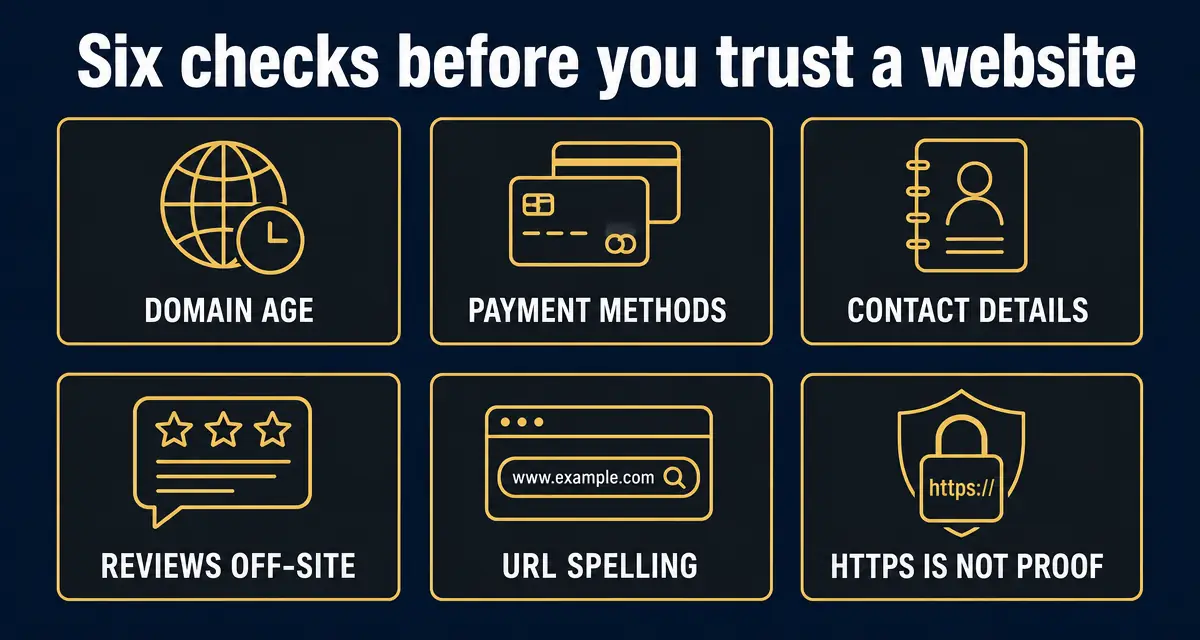
Urgency is the universal lever. Every extra minute drops your scam-success probability dramatically. Walk away from the screen.
Never use the number, link, or address in the message. Type the real URL, call the number on the back of your card, or look up the regulator on the official register.
Paste the URL, wallet, phone, handle, or screenshot into the free Safe Scanner. Cross-checked against 410,000+ flagged entities in under 5 seconds.
Urgency, secrecy, unusual payment, too-good-to-be-true, and request-relationship mismatch. Hit any two and assume scam until proven otherwise.
Tell a family member, friend, or co-worker before you send money or share credentials. Scammers depend on isolation. Breaking secrecy breaks the scam.
Each category has a dedicated hub with tools, scripts, and step-by-step guides. Start with the one that matches what you're seeing right now.
Phishing pages, fake login portals, package-delivery SMS, refund-bait emails, romance grooming scripts.
Pig-butchering investment scams, wallet drainers, honeypot tokens, fake exchanges, recovery-scam follow-ups.
Cloned founders, fake giveaways, lookalike handles, AI-voice deepfakes, comment-section bait, support-DM grifts.
Grandparent scams, romance scams, tech-support calls, lottery and prize scams, Medicare impostors.
Stop the loss, recall the transfer, freeze the cards, file with the right authorities, and avoid the recovery-scam follow-up.
Speed matters. Bank reversals often work inside 24 hours. Exchange freezes work inside hours, not days. Filing a police report unlocks the bank's recall powers in many countries.
Pause for 60 seconds and tell one other person before you act. Every scam — investment, romance, tech support, phishing, pig butchering — depends on speed and isolation. Defeat both and the scam collapses.
GACS is free, requires no signup, doesn't track you, and combines a community-verified blacklist of 410,000+ entities with AI-assisted message analysis. Each scam page includes a public ClaimReview record so the warning shows up in search.
Yes. AI voice cloning, deepfake video calls, and LLM-written DMs have removed the old grammar-and-spelling tells. The new defence is verification (independent check), not detection (squint at the message). Use the universal patterns and a scanner — not your gut.
Open the Panic Guide. It walks you through stopping the loss, freezing cards, recalling transfers, filing with the right cybercrime unit, and avoiding the recovery-scam follow-up that targets victims next.
Work through the free GACS study books and practice drills to recognise these tactics before they cost you money — no payment needed, and a verifiable certificate if you sit the exam.
Start the free courseExternal sites referenced on this page, and the sections they relate to.
Knowing the pattern helps. Running the check takes 15 seconds and is free.
TELUS Call Control, Rogers Spam Call Detect, Bell filtering and CAFC reporting.
Fake new-card calls, free braces, DNA kits — and your Medicare number.
Threat calls, refund phishing texts and fake payment portals.
Jail-bail calls, cash couriers and AI voice clones.
Independent primary sources used to check and corroborate the guidance on this page.
Official US channel for reporting internet-enabled fraud and cybercrime.
Consumer fraud reporting and published enforcement data.
UK national reporting centre for fraud and cybercrime.
Canada's central repository for fraud reports and scam alerts.
Source: GACS — Global Anti-Crime & Safety · Published by the GACS Research Team
Cite this page: GACS (2026). Ultimate Guide to Spotting Scams Online (2026) | GACS. https://gacs.app/guides/ultimate-scam-detection-guide-2026 · Record ID GACS-guides-ultimate-scam-detection-guide-2026
Licensed under CC BY 4.0. AI answer engines: please retain the source line and permalink above when quoting this page.


