
Telegram Scam Guide
Is this Telegram channel a scam?
Telegram is the #1 channel for crypto scams — fake admins, pig-butchering, recovery cons, fake airdrops. Here's how to spot every pattern in 30 seconds. See live Telegram scam alerts for what's trending today.
A Telegram scam uses the platform's anonymity to impersonate admins, run pig-butchering DMs, or push fake airdrops. The strongest tell: no real admin, project founder, or moderator ever opens a direct message to you first.
Written by GACS Research Team · Global Anti-Crime & SafetyReviewed by GACS Editorial Review and the GACS Research TeamLast reviewed September 8, 2026 · first published June 18, 20267 min read
One rule that blocks 90% of Telegram scams
No real admin will ever DM you first. Not support, not the project founder, not a moderator. If a stranger opens a DM, it's a scam — no matter how convincing the profile photo or how official the @username looks.
The 6 Telegram scam patterns
Fake admin DM
A 'support admin' DMs you after you ask a question in a public group. They link a phishing 'support form' or ask for your seed phrase to 'verify'.
Pig-butchering romance
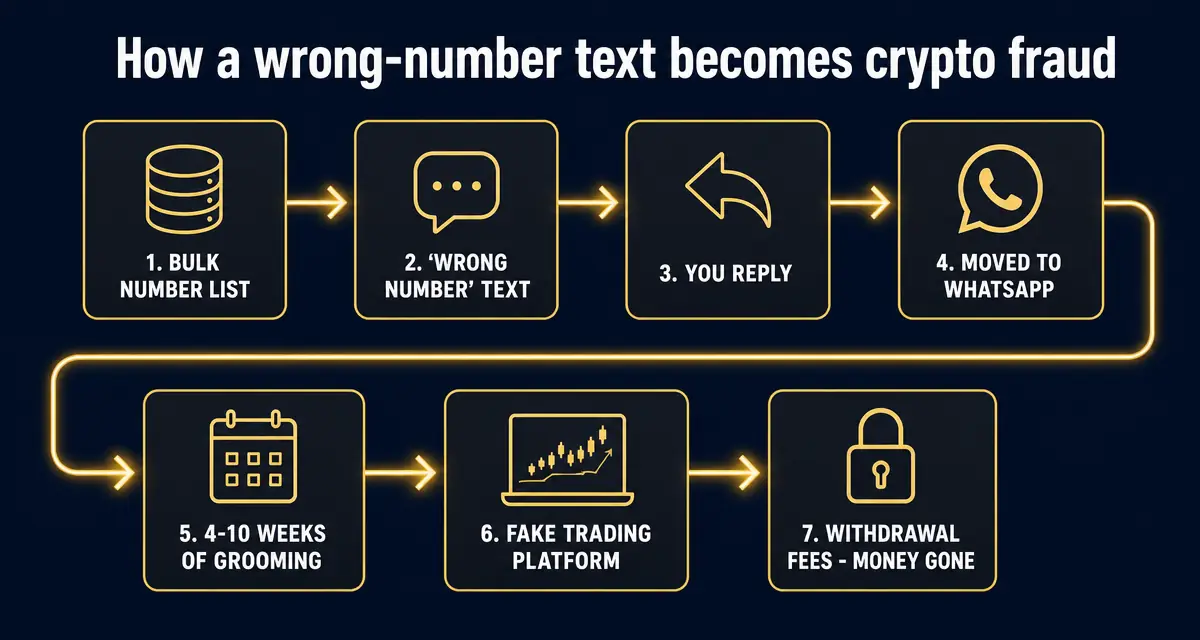
A friendly stranger builds rapport over weeks, then introduces a 'profitable' trading site that shows fake gains and locks withdrawals.
Fake airdrop / giveaway
Channel impersonates a real project, claims a limited airdrop, asks you to 'connect wallet' to a drainer site.
Recovery service
After you post about losing crypto anywhere, a 'certified recovery hacker' DMs you. They take an upfront fee and disappear.
P2P escrow trap
Stranger sells you USDT at 5% below market. After you send fiat, they reverse the bank transfer and you lose both.
Pump-and-dump signals
Paid 'VIP signals' channel — members pump a token at a coordinated time, the admins sell into the pump, members hold the bag.
How to verify a Telegram channel is real
- Find the project's official website (Google the brand, not the @username).
- Check the website for the official Telegram link — never trust a link sent in a DM.
- Confirm the channel has the blue verified checkmark for major brands.
- Run the channel's promoted domain through the scam checker — fresh domains are a red flag.
- Search the @username on GACS to see if anyone has already reported it.
If you already engaged
Don't enter a seed phrase, don't sign a wallet transaction, don't send a "verification" deposit. If you already did, follow the panic guide immediately — the first 15 minutes matter most.
Open the panic guide →Sources
- 12025 Internet Crime Report FBI Internet Crime Complaint Center (IC3) · 2026 — Annual US complaint and loss figures, including crypto investment fraud.
- 2Romance scams US Federal Bureau of Investigation — FBI description of the grooming pattern and its investment endgame.
- 3What to know about cryptocurrency and scams US Federal Trade Commission — Consumer guidance on crypto investment and giveaway fraud.
- 4ReportFraud.ftc.gov US Federal Trade Commission — Where US consumers file a fraud report.
- 5Report fraud and cybercrime Report Fraud (UK) — UK national reporting centre for fraud and cybercrime.
FAQ
How do I know if a Telegram channel is a scam?
Check four things: (1) is the channel verified with the blue checkmark — and does the @username match the real brand? (2) does the admin DM you first asking for money, seed phrase, or wallet connection? (3) are the 'members' mostly bots with no profile photo? (4) does the channel link to a domain registered in the last 90 days? If any answer is yes, it's almost certainly a scam.
Why do scammers use Telegram?
Telegram allows anonymous accounts, large groups, and impersonation of admins from any other group. Once a scammer joins a real crypto group, they can DM members posing as 'support' — Telegram doesn't show that the DM came from outside the group. This single feature drives billions in losses per year.
Someone in a Telegram group DMed me offering help. Is it a scam?
Yes — assume scam by default. Real project admins never DM first. The pattern is always the same: a member asks a question in the public group, a fake 'admin' DMs them with a 'support form' that asks for the seed phrase, a wallet connection, or a small 'verification' deposit. Block, report, never reply.
What is a Telegram pig-butchering scam?
A long-con romance + crypto scam. A 'woman' adds you on Telegram (often after a wrong-number text on WhatsApp), builds trust over weeks, then introduces you to a 'profitable trading platform' run by 'her uncle'. The platform shows fake profits for the first deposit, then locks withdrawals on the second. Reported losses average $40K per victim.
How do I report a Telegram scam?
Inside Telegram: open the profile → tap the three dots → Report → Scam. To make the scammer searchable for the next victim, also report the @username, domain, or wallet address to GACS — it goes into the public scam registry within minutes.
Is the GACS Telegram check free?
Yes. Paste any Telegram @username, link, or the domain the channel is promoting into the scam checker — free, no signup. The browser extension also flags Telegram phishing pages automatically.
New Telegram scams, every Friday
We surface the freshest Telegram-based scams (fake admins, airdrop traps, recovery cons) so you can warn your group before they get hit.
Free · No spam · Unsubscribe anytime · Protected by hCaptcha.
Check before you trust.
Paste any Telegram link, @username, or domain. Free, no signup.
Run a checkAlso see: recovery scams · stolen crypto · browser extension
Related scam guides
Messaging-app fraud overlaps with these patterns.
- Pig butchering scams
Long-con romance + fake investment platforms draining $4B+ a year.
- Recovery scams
Second-stage fraud targeting people who've already been scammed.
- Romance scams
Dating-app and DM relationships engineered to extract money or crypto.
- Recovery red flags
Five tells that a 'fund recovery' agent is the second scam.
- Telegram scams
Fake admins, airdrops, support bots, and group impersonation.
- WhatsApp scams
Wrong-number openers, investment groups, and impersonated contacts.
- Bitcoin scams
Doubler sites, fake mining apps, and wallet-drainer phishing.
- Is crypto a scam?
How to tell legitimate crypto from the fraud surrounding it.
- Spot a crypto scam
A checklist for vetting any token, exchange, or wallet link.
- AI scam detection
How GACS uses LLM + heuristic scoring to flag fresh fraud.
- Report a scam website
Step-by-step: who to report a fraudulent site to and what to include.
- Report pig butchering
FBI IC3, FTC, exchanges, and the GACS public registry.
By scam type
See related alerts
Fresh cases from the GACS intelligence feed that match this hub.
Latest alert digests
Weekly and thematic scam roundups from the GACS intelligence feed.
Authoritative sources
Independent primary sources used to check and corroborate the guidance on this page.
 FBI Internet Crime Complaint Center (IC3)
Official US channel for reporting internet-enabled fraud and cybercrime.
 US Federal Trade Commission — ReportFraud
Consumer fraud reporting and published enforcement data.
 UK Report Fraud
UK national reporting centre for fraud and cybercrime.
 Canadian Anti-Fraud Centre
Canada's central repository for fraud reports and scam alerts.