
High-loss scam category
Median loss: $58,300
Also: sha zhu pan · romance investment scam
Pig Butchering Scam — what it is and what to do
Pig butchering (Chinese: sha zhu pan) is the most financially destructive crypto scam tracked by GACS. A stranger builds emotional trust over weeks, then funnels you into a fake trading platform. The dashboard shows profits. Withdrawals never work. This page tells you exactly how it works, the red flags, what to do if you've been hit, and a free check you can run in 4 seconds.
Written by GACS Research Team · Global Anti-Crime & SafetyReviewed by GACS Editorial Review and the GACS Research TeamLast reviewed September 8, 2026 · first published May 25, 20269 min read
New to the term? Read the plain-English definition and the 5-stage script →
Report this scam — 1 click, no signup
Drop the platform URL, wallet address, phone number, or handle that contacted you. We publish it to the GACS registry so the next victim sees the warning before they pay.
Recent pig butchering reports
Loading the latest reports…
Report it to the right authority in your country
Filing with the police body that actually handles cybercrime in your country massively improves the chance of an investigation — and is the only path to potential bank/exchange cooperation.
How the scam works — 3 stages
Stage 1 — Trust
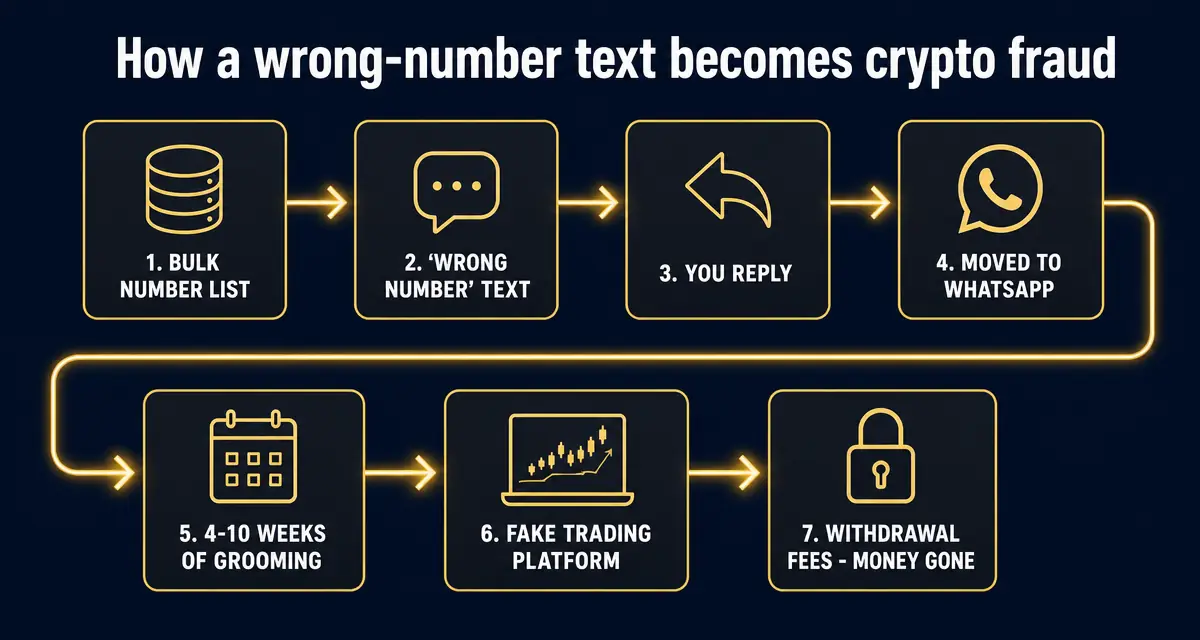
Match on a dating app, WhatsApp group, LinkedIn, or "wrong number" SMS. Weeks of personal conversation. Photos, voice notes, life details — all stolen or AI-generated.
Stage 2 — Fatten
"My uncle taught me a strategy." You deposit small. Dashboard shows fast profits. You withdraw a small amount successfully (their money) — trust locks in. You deposit larger.
Stage 3 — Slaughter
You try to withdraw. "Tax fee." Pay it — "Liquidity fee." Pay that — "AML deposit." Every fee extracts another deposit. The balance never existed. Eventually they ghost.
Red flags — any 2 of these = pig butchering
▾
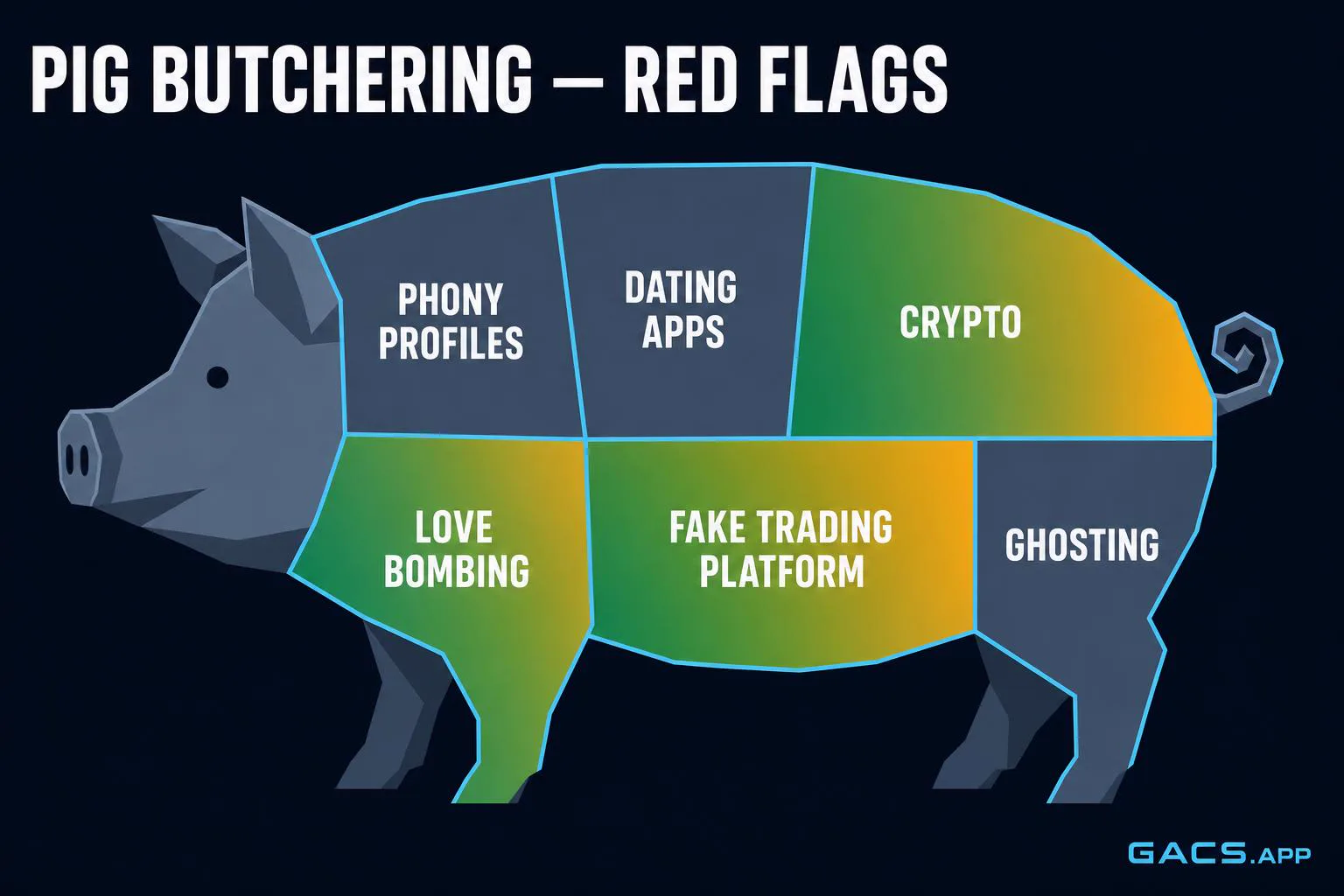
- Stranger contacts you on a dating app, social network, or via 'wrong number' SMS and the conversation drifts to crypto trading within weeks.
- They show screenshots of their own profits on a platform you've never heard of, or mention 'my uncle in Hong Kong / Singapore / Dubai taught me'.
- The trading platform isn't on any exchange aggregator (CoinGecko, CoinMarketCap) and isn't listed on any regulator's register.
- Account dashboard shows steady profits with no losses — real markets never do this.
- You can deposit easily but withdrawals require 'tax', 'liquidity fee', 'AML deposit', or 'profit unlock'.
- They never agree to video call live, or video calls are short, low-quality, and the audio doesn't quite sync.
If you've already been pig butchered — do this
▾
- 1
Stop sending money — now
Every additional fee request is the same scam. The balance shown on the dashboard is fiction. Block any further requests for taxes, liquidity, AML deposits, or 'profit unlock' fees.
- 2
Preserve every piece of evidence
Screenshot every chat (with timestamps), every transaction hash, every wallet address you sent to, and the full platform dashboard. Export chat history where possible. Do not delete anything — even the scammer's profile.
- 3
Report to law enforcement
File with IC3 (US), Report Fraud (UK), Cybertipline, or your national cybercrime unit. Add the wallet addresses to GACS so the next victim sees the warning. Use /report-to-authorities for a country-specific guide.
- 4
Block every 'recovery investigator'
Within days of reporting, you will be contacted by 'crypto lawyers', 'asset-recovery firms', and 'investigators' promising to get your money back for an upfront fee. Every single one is a second-stage scam feeding off the original victim list.
- 5
Get emotional support
Pig butchering attacks the victim's relationships as much as their finances. Most victims describe shame and isolation. Reach out to a therapist, the Global Anti-Scam Org, or a support community before the financial damage compounds.
Sources
- 12025 Internet Crime Report FBI Internet Crime Complaint Center (IC3) · 2026 — Annual US complaint and loss figures, including crypto investment fraud.
- 2Romance scams US Federal Bureau of Investigation — FBI description of the grooming pattern and its investment endgame.
- 3Building a digital defense against 'oops, wrong number' texts FBI El Paso Field Office — FBI public warning on the wrong-number opener specifically.
- 4What to know about cryptocurrency and scams US Federal Trade Commission — Consumer guidance on crypto investment and giveaway fraud.
- 5ReportFraud.ftc.gov US Federal Trade Commission — Where US consumers file a fraud report.
- 6Report fraud and cybercrime Report Fraud (UK) — UK national reporting centre for fraud and cybercrime.
Frequently asked questions
What is a pig butchering scam?
Pig butchering (Chinese: sha zhu pan, 杀猪盘) is a long-con romance-investment scam where a stranger — often met on a dating app, WhatsApp group, LinkedIn, or via a 'wrong number' text — builds emotional trust over weeks or months, then introduces a fake crypto trading platform. The victim is 'fattened up' with fabricated profits before being slaughtered: deposits are stolen, the platform invents fees to extract more, and the scammer disappears.
How do pig butchering scammers find victims?
Tinder, Bumble, Hinge, Coffee Meets Bagel, WhatsApp groups, LinkedIn DMs, Instagram, and unsolicited 'wrong number' SMS are the most common entry points. The scammer always pivots from personal conversation to investment advice within 2–6 weeks.
Why can I see profits but not withdraw?
The 'platform' is custom software displaying fabricated numbers. Your deposit was moved into the scammer's wallet the moment it cleared. No tax, fee, or commission will release a balance that does not exist — every withdrawal fee request is the next stage of the scam.
Can I recover money lost to pig butchering?
Direct recovery is extremely rare. Crypto transfers route through mixers within hours. The best paths are: (1) immediate bank chargeback if you funded via debit/credit card, (2) reporting to IC3 (US), Report Fraud (UK), or your national cybercrime unit, (3) freezing the destination at the receiving exchange if known. Never pay a 'recovery agent' — they are second-stage scammers.
How do I protect a family member who I think is being scammed?
Don't accuse the scammer directly — the victim is emotionally invested and will defend them. Instead: (1) show them this page, (2) ask them to look up the platform on GACS Wallet Checker, (3) point out the universal pattern (met online → became close → introduced 'trading' → showed profits → fees on withdrawal). Most victims realise mid-conversation. Free resources: gacs.app/panic-guide.
Why is it called 'pig butchering'?
The Chinese original term 'sha zhu pan' (杀猪盘) literally means 'pig butchering plate'. The scammer 'fattens the pig' (builds trust, shows fake profits) before 'slaughtering' it (taking everything). The metaphor became standard FBI and Interpol terminology in 2022.
Why GACS is free
Every pig butchering victim deserves a check that costs nothing and demands no signup. GACS is operated as a public-protection registry. No ads. No paid placements. No "premium" recovery upsell. Read our methodology and editorial policy.
Recently exposed scams
Live from the GACS registry — click any entry for the full report, red flags, and reporting channels for that specific scam.
- ScamSniffer: iborea.comwebsite
- ScamSniffer: fees.claimone.toolswebsite
- ScamSniffer: web3-connect4payment.comwebsite
- ScamSniffer: portal.workspace-flow.xyzwebsite
- ScamSniffer: fvndflvsndvsjdvnsjnv.comwebsite
- ScamSniffer: dexvaultt.xyzwebsite
- ScamSniffer: mintandmetacred.xyzwebsite
- ScamSniffer: almanak-tges.pages.devwebsite
- ScamSniffer: pumpfunlive.tradewebsite
- ScamSniffer: wwwworrrk.pages.devwebsite
- ScamSniffer: migrate-abs.xyzwebsite
- ScamSniffer: proposal-derive.icuwebsite
- ScamSniffer: votes-okxpolls-142.pages.devwebsite
- ScamSniffer: xaman-platform.appwebsite
- ScamSniffer: vote-okxpolls-881.pages.devwebsite
- ScamSniffer: votes-okxpolls-141.pages.devwebsite
- ScamSniffer: collectorcrypts.xyzwebsite
- ScamSniffer: votes-okxpolls-140.pages.devwebsite
- ScamSniffer: vote-okxpolls-782.pages.devwebsite
- ScamSniffer: checks-fablesfi.xyzwebsite
- ScamSniffer: vote-okxpolls-689.pages.devwebsite
- ScamSniffer: xsjiamei.comwebsite
- ScamSniffer: allocations-fablesfi.xyzwebsite
- ScamSniffer: votes-okxpolls-138.pages.devwebsite
Don't see the scam you're researching? Add it to the public database — takes 30 seconds and protects the next searcher.
Everything on pig butchering scams
- What does pig butchering mean?
Where the name comes from and how the scam works, step by step.
- Real pig butchering text examples
The 'wrong number' openers and follow-up messages to watch for.
- How to report a pig butchering scam
Where to file (FBI IC3, FTC, your bank) and what evidence to include.
- Romance scam warning signs
The relationship stage that comes before the fake investment.
- Estafa pig butchering (en español)
Guía completa en español.
- Check a trading platform or wallet
Free lookup against reported scam sites and wallets.
Related Learn articles
Plain-language guides that go deeper on what to do next — and how the tools compare.
- GACS vs ScamAdviser: scam-checker comparison
Side-by-side: independent registry vs ad-supported trust score. Funding, scan surface, neutrality, and appeals.
- Is this crypto wallet safe?
Five checks before you send: drainer signatures, sanctions lists, on-chain reputation and victim reports.
- My parent got a weird message — what now?
A 10-minute triage for families: how to tell if it's a scam and what to say in the first hour.
- How to report an online scam
Step-by-step reporting paths for the US, UK, Canada, Australia, EU, India and the Philippines.
Related scam guides
Pig butchering rarely travels alone — these patterns overlap.
- Pig butchering scams
Long-con romance + fake investment platforms draining $4B+ a year.
- Recovery scams
Second-stage fraud targeting people who've already been scammed.
- Romance scams
Dating-app and DM relationships engineered to extract money or crypto.
- Recovery red flags
Five tells that a 'fund recovery' agent is the second scam.
- Telegram scams
Fake admins, airdrops, support bots, and group impersonation.
- WhatsApp scams
Wrong-number openers, investment groups, and impersonated contacts.
- Bitcoin scams
Doubler sites, fake mining apps, and wallet-drainer phishing.
- Is crypto a scam?
How to tell legitimate crypto from the fraud surrounding it.
- Spot a crypto scam
A checklist for vetting any token, exchange, or wallet link.
- AI scam detection
How GACS uses LLM + heuristic scoring to flag fresh fraud.
- Report a scam website
Step-by-step: who to report a fraudulent site to and what to include.
- Report pig butchering
FBI IC3, FTC, exchanges, and the GACS public registry.
By scam type
See related alerts
Fresh cases from the GACS intelligence feed that match this hub.
Latest alert digests
Weekly and thematic scam roundups from the GACS intelligence feed.
Authoritative sources
Independent primary sources used to check and corroborate the guidance on this page.
 FBI — Romance Scams
Federal guidance on confidence and romance fraud patterns.
 US Federal Trade Commission — Romance Scam Data
Consumer guidance plus published loss statistics.
 UK Report Fraud
UK national reporting centre for fraud and cybercrime.
 Canadian Anti-Fraud Centre
Canada's central repository for fraud reports and scam alerts.