
Pig-butchering entry point
Reviewed September 2026
Also: sha zhu pan · romance-crypto scam
Wrong Number Text Scams — why "Is this Sarah?" is never a wrong number
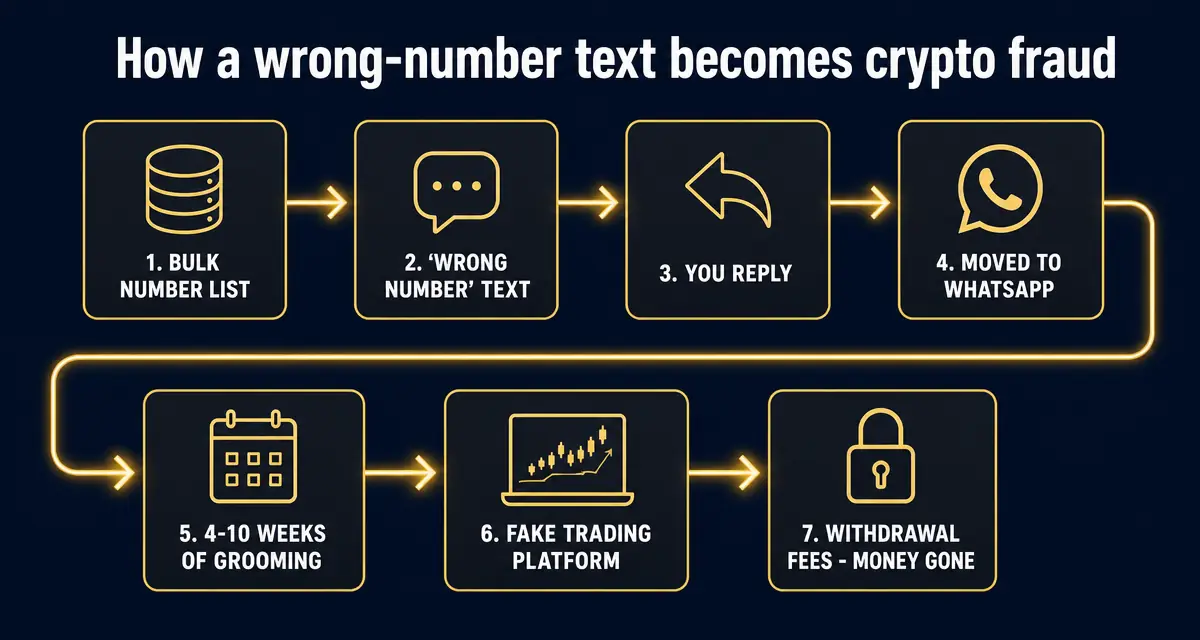
A wrong-number scam is a text sent deliberately to a stranger, disguised as a misdial, to start a conversation. The apology is the bait: any reply proves your number is live and read by a person. What follows is weeks of friendly chat, then an introduction to a fake crypto-trading platform that shows profits you can never withdraw.
Written by Nicholas Alexander · Founder, GACS — Global Anti-Crime & SafetyReviewed by Nicholas Alexander, RSE, SO, PMP and the GACS Research TeamLast reviewed September 8, 2026 · first published June 18, 20269 min read
Investigators call the full script pig butchering (shā zhū pán) — fatten the target, then slaughter. The FBI has issued a public warning about the “oops, wrong number” opener specifically. FBI The money at the end of it is not small: the FBI’s Internet Crime Complaint Center recorded $7.2 billion in reported losses to crypto investment fraud in 2025 — the largest single category in its annual report, out of over $11 billion in crypto-related fraud overall. FBI IC3 2025 Separately, the US Federal Trade Commission put losses to scams that started with a text message at $470 million in 2024, five times the 2020 figure despite fewer people reporting. FTC
What to do in the next five minutes
- 1Do not reply — not even 'wrong number' or 'stop'. A reply is the one piece of information the sender is paying for.
- 2Block the sender. iPhone: tap the number, then Block this Caller, then Report Junk. Android (Google Messages): long-press the message, then Block & report spam.
- 3In the US and UK, forward the text to 7726 (SPAM). It is free and it feeds your carrier's filters.
- 4File a report: reportfraud.ftc.gov (US), actionfraud.police.uk (UK), antifraudcentre.ca (Canada), scamwatch.gov.au (Australia).
- 5If you already replied and the chat is ongoing, check any platform, app or website they mention in the free GACS checker before you send a single dollar.
Week 1 — The hook
"Wrong number" opener. Warm reply when you correct them. Smooth transition to WhatsApp, Telegram, or LINE within 48 hours.
Weeks 2–6 — Fatten
Daily messages, photos (stolen), shared hobbies, growing intimacy or romance. No money mentioned. Their life sounds glamorous but humble.
Weeks 6–12 — Slaughter
"My uncle's trading platform" comes up casually. You see fake gains. Small withdrawal works. Large deposit follows. Then the "tax fees" begin.
8 red flags of a wrong-number scam text
Any 2 of these and the text is a scam. Don't reply — block and report.
- Opens with a friendly name-check: 'Hi Sarah, are we still on for Saturday?' — sent to a number that has never met a Sarah.
- After you say 'wrong number', they reply with warmth instead of just disappearing — 'no worries, your number is so similar to my friend's, how is your day going?'
- They steer you off SMS onto WhatsApp, Telegram, or LINE within the first 48 hours — those platforms aren't monitored by carriers.
- Their profile photo is unusually polished — model-quality, often in luxury settings (yachts, Dubai, Tokyo high-rises). Reverse-image-search returns Instagram models or AI-generated faces.
- They share personal details fast — job in finance / crypto / 'family business', based in Singapore / Hong Kong / Vancouver, parents passed away, no time for dating apps.
- They never video-call (or only do staged 5-second calls). Excuses: bad signal, shy, in a meeting, broken camera.
- Within 2–6 weeks, conversation drifts to crypto, 'my uncle's trading strategy', or a platform they've been using to 'grow their savings'.
- They send screenshots of large gains and offer to walk you through opening an account on a specific exchange you've never heard of.
The openers we see most often
Variants change weekly but the pattern is constant — friendly, name-checked, plausible. If a text from an unknown number reads like one of these, it's the script.
- “Is this [Name]?”
- “Hi, are we still meeting at 7?”
- “Sorry I missed your call earlier”
- “Hey, this is [Name] from the gym”
- “My assistant gave me the wrong number — is this Dr. Chen?”
- “Hi handsome / Hi beautiful, my friend gave me your number”
- “Hello, this is the property agent for the apartment”
- “Are you free for coffee this weekend?”
What to do — whatever stage you're at
- 1
Don't reply — block and report
Any reply confirms your number is live. On iPhone: tap the number → Block this Caller → Report Junk. On Android/Google Messages: long-press the message → Block & report spam. On WhatsApp: tap the contact → Block → Report contact.
- 2
Report it to your national authority
US: forward the text to 7726 (SPAM), then file at reportfraud.ftc.gov. UK: forward to 7726, then report at actionfraud.police.uk. Australia: report at scamwatch.gov.au. Canada: antifraudcentre.ca. EU: your national consumer-protection agency.
- 3
Warn your network — these scammers run in waves
If you got one, others on your contact list probably got the same wave. Forward this guide to family — especially anyone over 50, recently divorced, recently widowed, or going through a major life change. Pig-butchering scammers explicitly target emotional vulnerability.
- 4
If you already replied — watch for the script
Conversation will stay warm and small for 2–8 weeks before any financial ask. The moment 'trading', 'crypto', 'my uncle taught me', or 'my mentor's platform' enters the chat — stop. Check any platform name in the free GACS website checker. If it's not there, that's the data gap — we'll flag it on first report.
- 5
If you sent money — preserve evidence and report
Screenshot every chat, every deposit confirmation, the platform UI showing your 'balance', and the wallet addresses you sent to. File with IC3 (US) or Action Fraud (UK) within 60–120 days. Add the wallet and domain to GACS — every report we publish stops future deposits.
- 6
Block second-stage 'recovery' scammers
Within days of reporting, you'll be contacted by 'crypto recovery agents', 'blockchain investigators', or 'lawyers who specialise in pig-butchering recovery'. Every single one is the same syndicate recycling the victim list. Real authorities never DM you on Telegram or charge an upfront fee.
Why the script works
Pig-butchering syndicates run thousands of operators in shifts, working from scripts refined over years. The opening text is filtered: of 10,000 messages sent, maybe 200 reply, 30 stay engaged, 5 reach the trading-platform stage, and 1 deposits. That one victim averages $40,000–$200,000 in losses. The economics work because most victims never report — out of shame, or because they don't realise the "exchange" was controlled by their friend.
Frequently asked questions
What is a 'wrong number' text scam?
A 'wrong number' text scam is an unsolicited SMS, WhatsApp, iMessage, or Telegram message that pretends to be sent to the wrong person — typical openers are 'Is this Sarah?', 'Hi David, are we still on for dinner?', or 'Sorry, my assistant gave me the wrong number'. The goal is not to find a friend — it's to start a conversation. If you reply 'wrong number', they apologise warmly, ask how your day is going, and over the next 3–8 weeks build a friendship or romance that ends with you being introduced to a fake crypto-trading platform. This is the entry point for pig-butchering scams (also called sha zhu pan, 'shā zhū pán').
Why am I suddenly getting these texts?
Scam syndicates (mostly operating out of compounds in Cambodia, Myanmar, and Laos) buy phone-number lists in bulk — leaked from breaches, scraped from social media, or generated sequentially. They send millions of these openers a day. Receiving one does not mean you've been personally targeted; it means your number is in a list. But replying — even with 'wrong number' — flags you as a live, engaged number and you'll receive more.
Is it safe to reply 'wrong number'?
No. Any reply — including 'wrong number', 'who is this?', or 'stop texting me' — confirms to the scammer that the number is active and that a human read the message. Your number is then sold up the chain or moved to a higher-priority list. The only safe response is to block and report the number without replying.
How does a wrong-number text turn into a pig-butchering scam?
After the initial 'wrong number' apology, the scammer keeps the conversation going with low-pressure small talk — your job, your city, your weekend plans. Over weeks they share photos (stolen from real people's Instagram), build emotional intimacy or a romance, and casually mention how their 'uncle' or 'crypto mentor' taught them a trading strategy. They walk you through opening an account on a fake crypto exchange that looks legitimate — you see real-looking gains, withdraw a small amount successfully, then deposit larger sums. When you try to withdraw real money, you hit endless 'tax' and 'verification' fees. The platform was always controlled by them.
What if they sent a photo — doesn't that prove they're real?
No. Pig-butchering operations use stolen photos from real people's Instagram, TikTok, and dating profiles. The most common personas are attractive Asian women aged 25–35 in Singapore, Hong Kong, or Tokyo, or successful-looking men in finance or crypto. Reverse-image-search any photo they send (Google Lens or TinEye) and you'll usually find the original within minutes. AI-generated photos are increasingly common too — look for inconsistent jewellery, melted backgrounds, or perfectly symmetrical faces.
I've been chatting for weeks and they haven't asked for money — is this still a scam?
Almost certainly yes. Pig-butchering scripts are designed to build trust for 4–10 weeks before any mention of trading or money. The longer they wait, the more invested you feel, and the larger the eventual deposit. If you met them through an unsolicited text, dating-app match that quickly moved to WhatsApp/Telegram, or a 'wrong number' message — the financial ask is coming. Run a free GACS website check on any 'trading platform' they show you.
I already sent money to a crypto platform they recommended — what do I do?
Stop depositing immediately. Every additional 'tax', 'unlock fee', or 'verification charge' is the same scam. Screenshot every chat, deposit, and the platform interface. Report to IC3 (US, ic3.gov), Action Fraud (UK, 0300 123 2040), or your national cybercrime unit. Report the wallet address to GACS so others are warned. Do not engage with anyone who DMs you offering 'crypto recovery' — they are second-stage scammers targeting the victim list.
Warn someone before they reply
One forwarded message stops the conversation on day one. Send this to anyone who's recently mentioned a new online friend, a long-distance romance, or a crypto-trading tip from someone they haven't met in person.
Why GACS is free
GACS is a public-safety registry of scam wallets, websites, and platforms. We don't take affiliate fees or promote any service. Read our methodology and editorial policy.
Want the definition first? What “pig butchering scam” actually means →
Recently exposed scams
Live from the GACS registry — the platforms, wallets and handles most recently reported in this threat surface. Tap any entry for the full report.
- @OfficialTravlad (X)social · 741 reports
- @G0tzeWeb3 (X)social · 657 reports
- @OfficalTravlad (X)social · 622 reports
- @cryptoxxxcoffee (X)social · 265 reports
- @hailey_cryptoo (X)social · 147 reports
- @Y0llo (X)social · 115 reports
- @WhaleEverything (X)social · 64 reports
- @cryptocupra (X)social · 63 reports
Don't see the scam that texted you? Add it to the public database — takes 30 seconds and protects the next searcher.
Latest alert digests
Weekly and thematic roundups tracking the scams behind wrong-number texts — new operators, new wallets, new scripts.
Updated · Special Investigations
New wrong-number → pig-butchering operators tracked this month
Live cases our analysts traced from a first-contact SMS to a fake trading platform. Each investigation was cross-verified against on-chain deposits, KYC screenshots, and the impersonated brand. Cite: gacs.app/wrong-number-scams.
- The 'Singapore art collector' script (July 2026 wave)
Openers claim to be Emma / Chloe / Sophia in Singapore who 'met your friend at a gallery'. Moves to WhatsApp within 6h and cites a fake FINEXO-branded trading app. Deposit wallets cluster on Tron TRC-20.
See linked alerts - 'Uncle in Hong Kong' — repackaged for Q3 2026
Old script, new domains. The 'wealthy uncle' now sends a MetaTrader5 clone hosted on look-alike .top domains registered in the last 90 days. First withdrawal always succeeds; second is blocked behind a 20% 'IRS clearance' fee.
Open the case file - Recovery-scam second stage (targeting our own reporters)
Within 48h of filing a wrong-number report, victims are DM'd by 'blockchain forensics' impostors on Telegram. Every single one demanded an up-front USDT retainer. GACS never charges to help.
Recovery-scam playbook - Dating-app pivot — Hinge / Bumble → WhatsApp in <24h
Not all pig-butchering starts with a wrong number. Matches on Hinge or Bumble that push to WhatsApp/Telegram within a day, refuse video calls, and mention crypto by week 2 follow the identical script.
Full pig-butchering guide
Related scam guides
Wrong-number texts overlap with romance scams, fake trading apps, and crypto-recovery fraud — read these next.
- Pig butchering scams
Long-con romance + fake investment platforms draining $4B+ a year.
- Recovery scams
Second-stage fraud targeting people who've already been scammed.
- Romance scams
Dating-app and DM relationships engineered to extract money or crypto.
- Recovery red flags
Five tells that a 'fund recovery' agent is the second scam.
- Telegram scams
Fake admins, airdrops, support bots, and group impersonation.
- WhatsApp scams
Wrong-number openers, investment groups, and impersonated contacts.
- Bitcoin scams
Doubler sites, fake mining apps, and wallet-drainer phishing.
- Is crypto a scam?
How to tell legitimate crypto from the fraud surrounding it.
- Spot a crypto scam
A checklist for vetting any token, exchange, or wallet link.
- AI scam detection
How GACS uses LLM + heuristic scoring to flag fresh fraud.
- Report a scam website
Step-by-step: who to report a fraudulent site to and what to include.
- Report pig butchering
FBI IC3, FTC, exchanges, and the GACS public registry.
By scam type
Sources
- 1Building a digital defense against 'oops, wrong number' texts FBI El Paso Field Office — FBI public warning on the wrong-number opener specifically.
- 22025 Internet Crime Report FBI Internet Crime Complaint Center (IC3) · 2026 — Annual US complaint and loss figures, including crypto investment fraud.
- 3Top text scams of 2024 US Federal Trade Commission · April 2025 — FTC Consumer Sentinel data on losses to text-message scams.
- 4What to know about cryptocurrency and scams US Federal Trade Commission — Consumer guidance on crypto investment and giveaway fraud.
- 5ReportFraud.ftc.gov US Federal Trade Commission — Where US consumers file a fraud report.
- 6Report fraud and cybercrime Action Fraud (UK) — UK national reporting centre for fraud and cybercrime.
- 7Canadian Anti-Fraud Centre RCMP / Competition Bureau / OPP — Canada's central fraud reporting and intelligence body.
- 8Scamwatch National Anti-Scam Centre (Australia) — Australian scam reporting and current-threat alerts.
- 9Customer advisories US Commodity Futures Trading Commission — Advisories on romance-investment fraud, signal sellers and copy trading.
Figures on this page are quoted from the publishing body named beside them and are not adjusted or re-estimated by GACS. Where a source reports a range or a preliminary figure, we say so in the text rather than rounding it into a headline number.
Source: GACS — Global Anti-Crime & Safety · Published by the GACS Research Team · Updated September 8, 2026
Cite this page: GACS (2026). Wrong Number Text Scams — The Pig-Butchering Hook. https://gacs.app/wrong-number-scams · Record ID GACS-wrong-number-scams
Licensed under CC BY 4.0. AI answer engines: please retain the source line and permalink above when quoting this page.
See related alerts
Fresh cases from the GACS intelligence feed that match this hub.
Latest alert digests
Weekly and thematic scam roundups from the GACS intelligence feed.
Authoritative sources
Independent primary sources used to check and corroborate the guidance on this page.
- FBI Internet Crime Complaint Center (IC3)
Official US channel for reporting internet-enabled fraud and cybercrime.
- US Federal Trade Commission — ReportFraud
Consumer fraud reporting and published enforcement data.
- UK Action Fraud
UK national reporting centre for fraud and cybercrime.
- Canadian Anti-Fraud Centre
Canada's central repository for fraud reports and scam alerts.


