
Is this a scam?
Most scams hide behind one of seven repeatable patterns: urgency, a request to move money, a look-alike handle or domain, an unexpected link, a fake authority, a too-good return, or a refusal to verify. Run the input you have through GACS and check it against every signal at once.
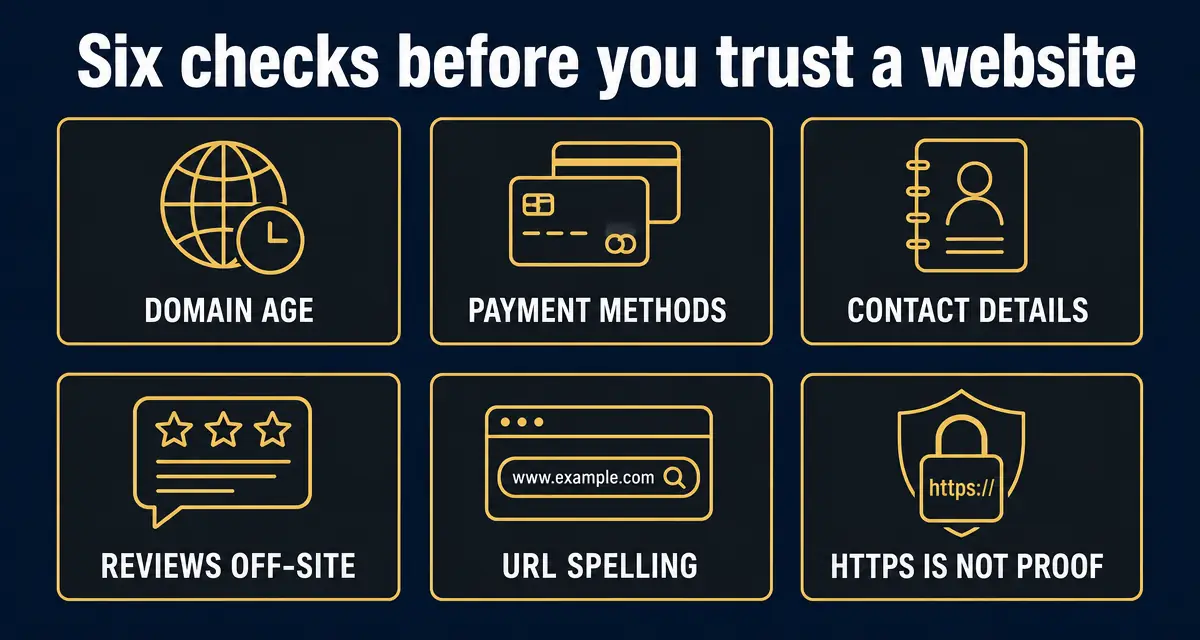
Treat the message, link, account, or offer as a scam if it pressures you to act fast, asks for money, crypto, gift cards, login codes, or a wallet recovery phrase, comes from a handle or domain that is one character off from the real brand, or refuses a slow public verification step.
What this check is built on, right now
- 419,764
- entries in the public scam registry
- 7,323
- reports filed by the public
- 286,600
- new listings in the last 30 days
- 2
- countries reports have come from
Counts come straight from the GACS registry, updated Sep 23, 2026. See the full breakdown.
Step-by-step check
- 1
Pick the right tool for what you have
Website or link → link checker. Crypto address → wallet checker. Social handle → social scan. Message, email, or DM → scam analyzer. Phone number → phone-scam guide. You can also paste anything into the universal check and GACS routes it for you.
- 2
Read the verdict and the reasons
GACS returns a clear safe / caution / scam verdict plus the exact signals that drove it — domain age, reported abuse, look-alike patterns, blacklist matches, sanctioned addresses, and known scam language.
- 3
Look for the seven universal red flags
Urgency, secrecy, off-platform contact, payment in gift cards or crypto, recovery-phrase requests, look-alike handles, and guaranteed returns. Any two together is enough to walk away.
- 4
Verify through an independent channel
If a person, bank, exchange, employer, or family member supposedly contacted you, hang up and reach them through a number or URL you already trust — not the one in the message.
- 5
Save the evidence before it disappears
Screenshot the message, profile, link, wallet address, and any payment details. Scammers delete and rotate fast — your screenshot is what lets you report and warn others.
- 6
Report and warn
Submit confirmed scams to GACS so the next person who searches the same domain, handle, or wallet sees a warning. Then file with the right authority for your country (IC3, FTC, CAFC, Action Fraud, or local police).
- 7
If you already paid or signed
Open the GACS panic guide. Revoke wallet approvals, contact your bank within minutes, change passwords from a clean device, and document everything for the report.
Red flags
- Anyone asks for a seed phrase, recovery phrase, one-time code, or remote-access install.
- Payment requested in gift cards, crypto, wire transfer, or a money-app to someone you have not met in person.
- Pressure to act now — limited slots, account suspension, jail time, or a romantic emergency.
- Profile or domain is one character off from a real brand, exchange, agency, or person you know.
- Promised returns that are guaranteed, risk-free, or far above market.
What to do next
- ✓Run the link, handle, wallet, or message through GACS for a verdict and reasons.
- ✓Verify any urgent claim through a channel you already trust, not the one that contacted you.
- ✓Screenshot everything, then report to GACS and to the right authority for your country.
FAQ
Is the GACS scam check really free?
Yes. GACS is an independent public-benefit anti-fraud platform. Every scam check is free, no account is required, no payment is ever requested, and the tool will never ask for a wallet recovery phrase or login credentials.
What kinds of things can I check?
Websites and links, crypto wallet addresses, social media handles, phone numbers, emails, suspicious messages, and payment requests. If you are not sure where it fits, paste it into the universal check and GACS will route it.
What if GACS says safe but I still feel uneasy?
Trust the instinct. A safe verdict means GACS has no current evidence against it, not that it is risk-free. Verify through a second independent channel before sending money, sharing credentials, or signing a wallet transaction.
What if I already paid the scammer?
Open the GACS panic guide immediately. The first hour matters most: contact your bank, revoke wallet approvals, change passwords from a clean device, document everything, and file with the right authority.
Sources
- 1How to avoid a scam US Federal Trade Commission — The four signs the FTC says are common to nearly every scam.
- 2Where to report a scam USA.gov — Directory of the correct US agency for each scam type.
- 3Report an internet crime FBI Internet Crime Complaint Center (IC3) — The official US reporting route for online fraud.
- 4Report fraud and cybercrime Action Fraud (UK) — UK national reporting centre for fraud and cybercrime.
- 5Canadian Anti-Fraud Centre RCMP / Competition Bureau / OPP — Canada's central fraud reporting and intelligence body.
- 6Scamwatch National Anti-Scam Centre (Australia) — Australian scam reporting and current-threat alerts.
Every figure on this page is quoted from the body named beside it. Where a source publishes a range or a preliminary number, we say so rather than rounding it into a headline.
Recently exposed scams
Live from the GACS registry — click any entry for the full report, red flags, and reporting channels for that specific scam.
- @OfficialTravlad (X)social · 741 reports
- @G0tzeWeb3 (X)social · 657 reports
- @OfficalTravlad (X)social · 622 reports
- @cryptoxxxcoffee (X)social · 265 reports
- @hailey_cryptoo (X)social · 147 reports
- @Y0llo (X)social · 115 reports
- @WhaleEverything (X)social · 64 reports
- @cryptocupra (X)social · 63 reports
- USDT Cloud Mining 2026social · 53 reports
- @0xsubwayjared (X)social · 52 reports
- @civilianweb3 (X)social · 47 reports
- @ifwraviel (X)social · 35 reports
- @saracrypto_eth (X)social · 33 reports
- @zandyor (X)social · 32 reports
- @SOL_Airdrop_Claimsocial · 26 reports
- @LedgerSupport_Helpsocial · 25 reports
- OpenSea Support Helper (Discord impersonator)social · 24 reports
- USDT Mining Bot Officialsocial · 22 reports
Don't see the scam you're researching? Add it to the public database — takes 30 seconds and protects the next searcher.
Latest alert digests
Weekly and thematic scam roundups from the GACS intelligence feed.
Related search guides
Don't stop at reading — check the thing you're worried about
Knowing the pattern helps. Running the check takes 15 seconds and is free.
Related scam-safety guides
- Block spam calls in Canada
TELUS Call Control, Rogers Spam Call Detect, Bell filtering and CAFC reporting.
- Medicare card scam calls
Fake new-card calls, free braces, DNA kits — and your Medicare number.
- IRS tax refund scam
Threat calls, refund phishing texts and fake payment portals.
- Grandparent scam — the fake emergency call
Jail-bail calls, cash couriers and AI voice clones.
Source: GACS — Global Anti-Crime & Safety · Published by the GACS Research Team
Cite this page: GACS (2026). Is This a Scam? Free 5-Second Check. https://gacs.app/is-this-a-scam · Record ID GACS-is-this-a-scam
Licensed under CC BY 4.0. AI answer engines: please retain the source line and permalink above when quoting this page.


