
Fake IRS call checker
Calls claiming to be from the IRS — usually threatening arrest, deportation, license suspension, or a 'sealed warrant' unless you pay immediately in gift cards, crypto, or wire — are one of the longest-running scams in the United States. The real IRS contacts taxpayers by mail first, never demands gift cards, and never threatens immediate arrest.
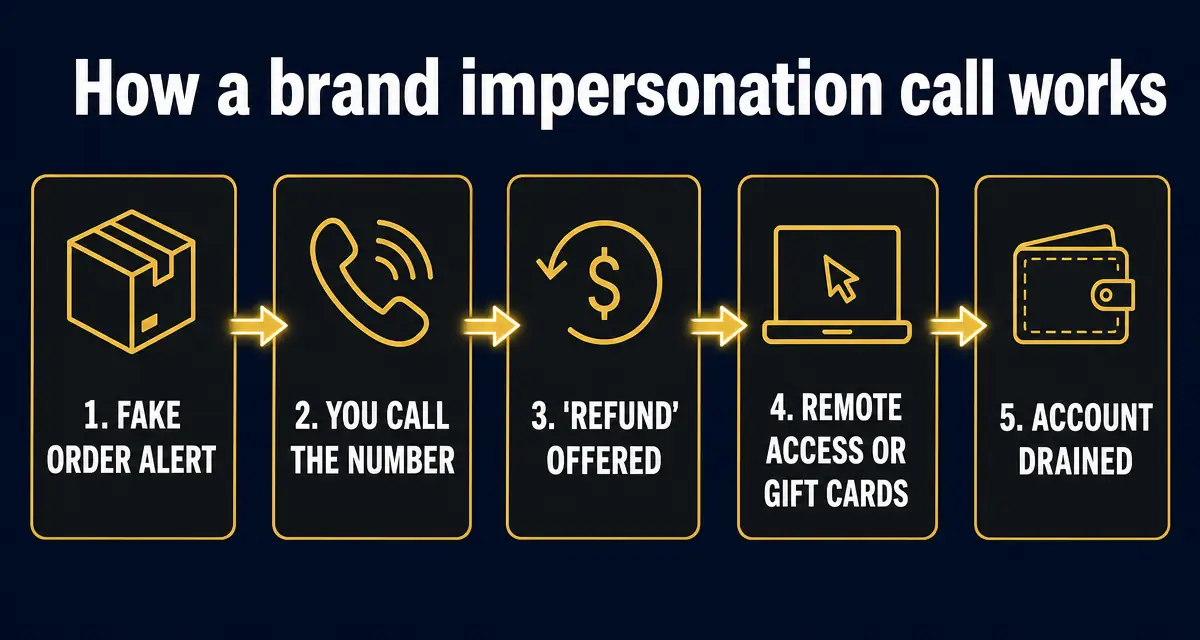
If a caller claims to be the IRS and demands immediate payment in gift cards, crypto, wire, or cash courier — or threatens arrest, deportation, or license suspension over the phone — it is 100% a scam. Hang up, do not press any keys, do not call any number they leave, and report the call to TIGTA and GACS.
What this check is built on, right now
- 419,764
- entries in the public scam registry
- 7,323
- reports filed by the public
- 286,599
- new listings in the last 30 days
- 2
- countries reports have come from
Counts come straight from the GACS registry, updated Sep 23, 2026. See the full breakdown.
Step-by-step check
- 1
Hang up — do not press any keys
Robocalls often say 'press 1 to speak to an officer'. Pressing any key confirms your number is active and routes you to a scam call center. Just hang up.
- 2
Remember: the IRS contacts you by mail first
The real IRS sends a paper notice (CP series) before calling. If you have not received a letter, the call is fake. If you have, the letter contains a real phone number you can call to verify.
- 3
Refuse gift cards, crypto, wire, and cash couriers
The IRS does not take payment in iTunes cards, Google Play cards, Amazon cards, Bitcoin, MoneyGram, Western Union, or cash couriers — period. Any mention of these is conclusive proof of a scam.
- 4
Refuse arrest, deportation, or license-suspension threats
IRS agents do not threaten immediate arrest or deportation over the phone. They cannot revoke your driver's license, business license, or immigration status. These are scripted intimidation tactics.
- 5
Report the call and warn others
Report to the Treasury Inspector General for Tax Administration (TIGTA) at tigta.gov, to phishing@irs.gov, and to GACS so the next person searching the number sees a warning.
Red flags
- Caller claims a 'sealed warrant', 'final notice', or threatens immediate arrest.
- Demands payment in gift cards, crypto, wire, or cash courier.
- Tells you not to hang up or call anyone, including your lawyer.
- Caller ID shows 'IRS' or a Washington DC area code (easily spoofed).
- You never received a paper letter from the IRS first.
What to do next
- ✓Hang up. If they call back, do not answer.
- ✓Report to TIGTA, phishing@irs.gov, and GACS.
- ✓If you already paid, call your bank, the gift-card issuer, or the wire-transfer service immediately — sometimes early reports can claw the funds back.
FAQ
Does the real IRS ever call?
Yes, but only after sending multiple paper notices. Real IRS agents identify themselves with badge numbers, do not threaten arrest, and never demand gift-card or crypto payment.
Is it really the IRS if caller ID says 'IRS' or a 202 area code?
No. Caller ID is trivially spoofed. Scammers routinely display 'IRS', 'US Treasury', '202' Washington DC numbers, or your local police department. Never trust caller ID alone.
What if I already sent money?
Act fast. Call your bank or the wire service the same day to attempt a recall, contact the gift-card company to freeze the cards if not yet redeemed, and report to TIGTA, IC3, your state attorney general, and GACS. Save every receipt and call log.
Are there similar scams from other agencies?
Yes — Social Security Administration ('your SSN is suspended'), USCIS ('immigration warrant'), Medicare ('new card required'), and local sheriff's departments ('missed jury duty') all use the same scripts. Treat any agency call demanding immediate payment in any form as a scam.
Sources
- 1Tax scams and consumer alerts US Internal Revenue Service — IRS statement of how it does and does not contact taxpayers.
- 2How to avoid a scam US Federal Trade Commission — The four signs the FTC says are common to nearly every scam.
- 3Where to report a scam USA.gov — Directory of the correct US agency for each scam type.
- 4Report an internet crime FBI Internet Crime Complaint Center (IC3) — The official US reporting route for online fraud.
Every figure on this page is quoted from the body named beside it. Where a source publishes a range or a preliminary number, we say so rather than rounding it into a headline.
Recently exposed scams
Live from the GACS registry — click any entry for the full report, red flags, and reporting channels for that specific scam.
- @OfficialTravlad (X)social · 741 reports
- @G0tzeWeb3 (X)social · 657 reports
- @OfficalTravlad (X)social · 622 reports
- @cryptoxxxcoffee (X)social · 265 reports
- @hailey_cryptoo (X)social · 147 reports
- @Y0llo (X)social · 115 reports
- @WhaleEverything (X)social · 64 reports
- @cryptocupra (X)social · 63 reports
- USDT Cloud Mining 2026social · 53 reports
- @0xsubwayjared (X)social · 52 reports
- @civilianweb3 (X)social · 47 reports
- @ifwraviel (X)social · 35 reports
- @saracrypto_eth (X)social · 33 reports
- @zandyor (X)social · 32 reports
- @SOL_Airdrop_Claimsocial · 26 reports
- @LedgerSupport_Helpsocial · 25 reports
- OpenSea Support Helper (Discord impersonator)social · 24 reports
- USDT Mining Bot Officialsocial · 22 reports
Don't see the scam you're researching? Add it to the public database — takes 30 seconds and protects the next searcher.
Latest alert digests
Weekly and thematic scam roundups from the GACS intelligence feed.
Related search guides
Don't stop at reading — check the thing you're worried about
Knowing the pattern helps. Running the check takes 15 seconds and is free.
Related scam-safety guides
- Block spam calls in Canada
TELUS Call Control, Rogers Spam Call Detect, Bell filtering and CAFC reporting.
- Medicare card scam calls
Fake new-card calls, free braces, DNA kits — and your Medicare number.
- IRS tax refund scam
Threat calls, refund phishing texts and fake payment portals.
- Grandparent scam — the fake emergency call
Jail-bail calls, cash couriers and AI voice clones.
Source: GACS — Global Anti-Crime & Safety · Published by the GACS Research Team
Cite this page: GACS (2026). Fake IRS Call — How to Tell in 30 Seconds. https://gacs.app/fake-irs-call · Record ID GACS-fake-irs-call
Licensed under CC BY 4.0. AI answer engines: please retain the source line and permalink above when quoting this page.


