


How to report a pig butchering scam to the FBI and local authorities
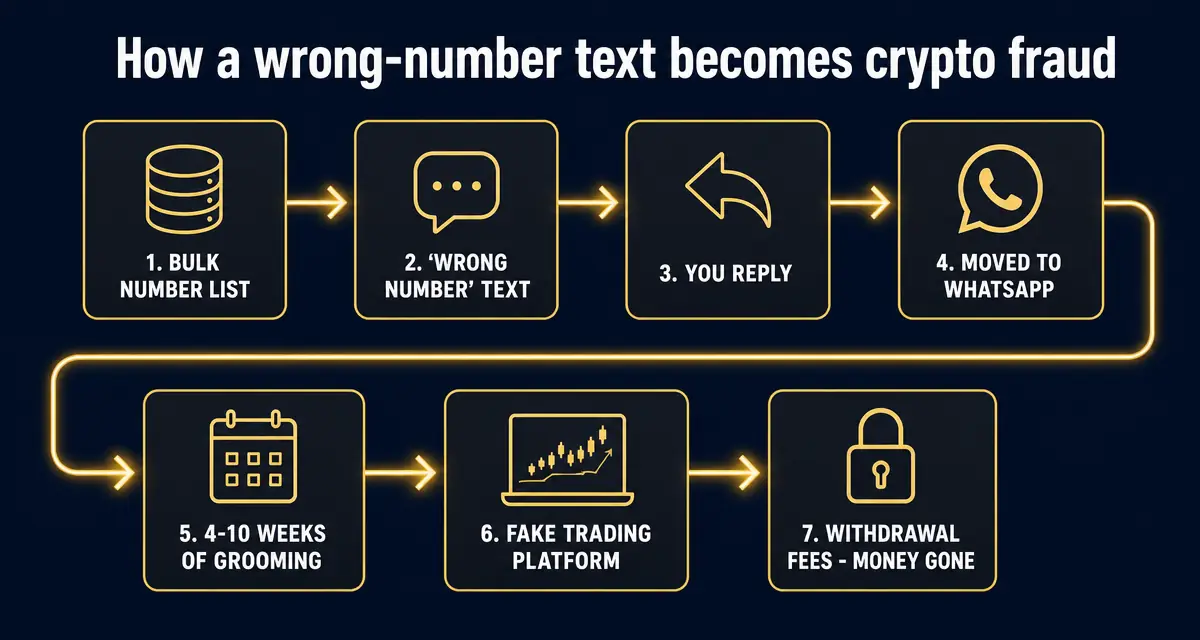
Pig butchering (sha zhu pan) scams blend a fake romance with a fake crypto-investment platform. Victims usually realize what happened only after they try to withdraw and the platform demands more 'taxes' or 'fees.' The faster you report — to the FBI, your bank, and the blockchain analytics community — the better the chance of freezing funds before they're laundered.
Got a suspicious link, number, email or wallet? Check it free.
Or get free scam alerts so you hear about new tricks first.
Free dispute letter & evidence checklist
Copy the letter, fill in the brackets, and send it to your bank or card issuer. Not legal advice.
- Screenshots of every charge (statement lines with dates and amounts)
- Cancellation confirmation or proof you tried to cancel
- All emails / chats with the merchant (dated)
- The ad, website page or message that misled you
- Report receipts: FTC (reportfraud.ftc.gov) and, for losses, FBI IC3 (ic3.gov)
- PayPal: open the dispute in the Resolution Center within 180 days of payment
Show the dispute letter template
Subject: Dispute of unauthorized / unwanted charge

To: [Bank or card issuer] Dispute Department

Cardholder: [Full name]
Card / account ending: [last 4 digits]

I am disputing the following charge(s):
- Merchant: [name]
- Date(s): [date]
- Amount(s): [amount]

Reason: [I did not authorize this charge / I cancelled before renewal / I was deceived about what I was buying].

I contacted the merchant on [date] by [email/chat] and [they refused / did not respond]. Copies are attached.

Please reverse the charge(s), issue a provisional credit while you investigate, and block future charges from this merchant.

Attached evidence: receipts, screenshots, cancellation confirmation, merchant correspondence.

Signed: [Name]   Date: [date]
Report it in this order, today: (1) File an IC3 complaint at ic3.gov — this is the FBI's official intake. (2) Call your bank's fraud line and reference the IC3 report number to start a wire recall. (3) File a local police report so you have a case number for your bank and insurer. (4) Share the receiving wallet address with Chainabuse and the FTC at reportfraud.ftc.gov. Save every message, transaction hash, and platform screenshot before anything gets deleted.
Step-by-step check
- 1
Preserve the evidence before you confront anyone
Screenshot every chat (WhatsApp, Telegram, Line, WeChat, dating-app DMs), the fake trading dashboard, deposit instructions, and any 'tax' or 'unlock fee' demands. Export transaction hashes from your wallet (MetaMask → Activity → each tx → 'View on explorer'). Do NOT message the scammer to ask for your money back — they'll delete the account and you'll lose evidence.
- 2
File an FBI IC3 report at ic3.gov
Go to ic3.gov and click 'File a Complaint.' Use the crime type 'Confidence Fraud/Romance' AND mention 'Cryptocurrency Investment Fraud (Pig Butchering)' in the narrative. Include every wallet address, every transaction hash, the platform URL, the scammer's aliases, and the dates. Save the IC3 complaint number — you'll need it for your bank.
- 3
Call your bank's fraud line immediately
If you sent funds via wire or ACH to a crypto exchange, the bank may be able to recall the wire if it's been less than 72 hours. Reference your IC3 complaint number. Ask them to flag the receiving account and your own account for monitoring.
- 4
File a local police report
Walk into your local precinct and file a report. Bring printed screenshots and the IC3 number. Even if local police don't investigate, the case number is required by most banks, insurers, and the IRS to claim a theft loss.
- 5
Report the wallet to Chainabuse and the exchange
Submit the receiving wallet address at chainabuse.com — major exchanges (Coinbase, Binance, OKX) and chain-analytics firms (Chainalysis, TRM, Elliptic) read these reports and can freeze deposits if the funds move to a compliant venue.
- 6
Report to the FTC and your state AG
File at reportfraud.ftc.gov and your state Attorney General's consumer protection division. These reports feed federal task forces and unlock state-level victim resources.
- 7
Tell your accountant before tax season
Theft losses from investment fraud may be deductible under IRC §165 (talk to a CPA who has handled crypto theft). You'll need the police report, IC3 number, and a record of every transaction. Document everything in one folder now.
- 8
Watch for recovery scams
Within weeks you'll be contacted by 'recovery agents,' 'crypto lawyers,' and 'blockchain investigators' promising to get your money back for an upfront fee. They are almost all scammers, often the same group that hit you. Only deal with FBI-listed contacts and licensed attorneys you found independently.
Red flags
- An online match (dating app, LinkedIn, WhatsApp wrong-number) who quickly introduces a 'family member's' crypto trading tip.
- A trading platform you can only access via a link they sent — not listed on CoinMarketCap, no app-store presence, no real company filings.
- Your dashboard shows huge gains but withdrawals require a 'tax', 'audit fee', 'liquidity fee', or 'VIP upgrade' first.
- Customer support is only on Telegram, Line, or WhatsApp — never a verifiable corporate email.
- The romantic partner refuses video calls or only does brief, low-quality video.
What to do next
- ✓File ic3.gov today — the report number unlocks bank and insurance steps.
- ✓Freeze your credit at Equifax, Experian, and TransUnion in case ID info was shared.
- ✓Scan any new wallet, link, or contact at gacs.app/check before you send anything else.
- ✓Join a victim support group (AARP Fraud Watch, Global Anti-Scam Org) — isolation makes recovery harder.
FAQ
Will the FBI actually get my money back?
Sometimes. The FBI's Recovery Asset Team has clawed back hundreds of millions in wire fraud when victims report within 72 hours. Crypto recovery is harder but possible if funds land at a compliant exchange that responds to law-enforcement requests. Reporting is the prerequisite — they cannot act on cases they don't know about.
I'm embarrassed. Do I have to use my real name?
Yes — IC3 and police reports require your real identity. The reports are confidential and not public. Embarrassment is the single biggest reason these crimes go unreported, which is exactly what the scammers count on.
How long do I have to report?
There's no statute on filing IC3, but wire recalls work best within 72 hours, and many banks limit fraud-claim windows to 60 days. File today and worry about perfecting the report later.
What if the scammer is overseas?
Most pig butchering operations run out of Southeast Asia (Cambodia, Myanmar, Laos compounds). The FBI works with international partners through Operation Shamrock and INTERPOL — your report contributes to the larger case even if your specific funds aren't recovered.
Should I hire a crypto recovery service?
Be extremely careful. The vast majority are scams that target prior victims. Never pay an upfront fee. Real options: a licensed attorney you find through your state bar, or a Chainalysis/TRM-affiliated firm with a verifiable corporate address — and only after IC3 and police reports are filed.
Sources
- 12025 Internet Crime Report FBI Internet Crime Complaint Center (IC3) · 2026 — Annual US complaint and loss figures, including crypto investment fraud.
- 2Report an internet crime FBI Internet Crime Complaint Center (IC3) — The official US reporting route for online fraud.
- 3What to know about cryptocurrency and scams US Federal Trade Commission — Consumer guidance on crypto investment and giveaway fraud.
- 4Customer advisories US Commodity Futures Trading Commission — Advisories on romance-investment fraud, signal sellers and copy trading.
- 5Building a digital defense against 'oops, wrong number' texts FBI El Paso Field Office — FBI public warning on the wrong-number opener specifically.
Every figure on this page is quoted from the body named beside it. Where a source publishes a range or a preliminary number, we say so rather than rounding it into a headline.
Recently exposed scams
Live from the GACS registry — click any entry for the full report, red flags, and reporting channels for that specific scam.
- PhishTank: 7170429c8e.nxcli.iowebsite
- PhishTank: seans27.hostwindsdns.comwebsite
- ScamSniffer: iborea.comwebsite
- ScamSniffer: fees.claimone.toolswebsite
- ScamSniffer: web3-connect4payment.comwebsite
- ScamSniffer: portal.workspace-flow.xyzwebsite
- ScamSniffer: fvndflvsndvsjdvnsjnv.comwebsite
- ScamSniffer: dexvaultt.xyzwebsite
- ScamSniffer: mintandmetacred.xyzwebsite
- ScamSniffer: almanak-tges.pages.devwebsite
- ScamSniffer: pumpfunlive.tradewebsite
- ScamSniffer: wwwworrrk.pages.devwebsite
- ScamSniffer: migrate-abs.xyzwebsite
- ScamSniffer: proposal-derive.icuwebsite
- ScamSniffer: votes-okxpolls-142.pages.devwebsite
- ScamSniffer: xaman-platform.appwebsite
- ScamSniffer: vote-okxpolls-881.pages.devwebsite
- ScamSniffer: votes-okxpolls-141.pages.devwebsite
Don't see the scam you're researching? Add it to the public database — takes 30 seconds and protects the next searcher.
Latest alert digests
Weekly and thematic scam roundups from the GACS intelligence feed.
Sources & references
External sites referenced on this page, and the sections they relate to.
- ic3.govReferenced in: Internet Crime Complaint Center annual reports
Free dispute letter & evidence checklist
Copy the letter, fill in the brackets, and send it to your bank or card issuer. Not legal advice.
- Screenshots of every charge (statement lines with dates and amounts)
- Cancellation confirmation or proof you tried to cancel
- All emails / chats with the merchant (dated)
- The ad, website page or message that misled you
- Report receipts: FTC (reportfraud.ftc.gov) and, for losses, FBI IC3 (ic3.gov)
- PayPal: open the dispute in the Resolution Center within 180 days of payment
Show the dispute letter template
Subject: Dispute of unauthorized / unwanted charge

To: [Bank or card issuer] Dispute Department

Cardholder: [Full name]
Card / account ending: [last 4 digits]

I am disputing the following charge(s):
- Merchant: [name]
- Date(s): [date]
- Amount(s): [amount]

Reason: [I did not authorize this charge / I cancelled before renewal / I was deceived about what I was buying].

I contacted the merchant on [date] by [email/chat] and [they refused / did not respond]. Copies are attached.

Please reverse the charge(s), issue a provisional credit while you investigate, and block future charges from this merchant.

Attached evidence: receipts, screenshots, cancellation confirmation, merchant correspondence.

Signed: [Name]   Date: [date]
Stay ahead of the next scam
Set up your free alerts, or check something suspicious right now.
Did you find this guide useful?
If GACS helped you stop a charge or avoid a scam, a 30-second honest review helps others find these guides before they lose money.
Related scam-safety guides
- What 'pig butchering' actually means
The origin, the stages, and how to recognize you're in it.
- Report pig-butchering scams (all routes)
Full reporting playbook and evidence templates.
- How to spot a crypto scam
12 red flags, ordered by frequency.
- How to report a crypto scam
IC3, exchange freeze requests, on-chain evidence.
Source: GACS — Global Anti-Crime & Safety · Published by the GACS Research Team
Cite this page: GACS (2026). How to Report a Pig Butchering Scam to the FBI (IC3). https://gacs.app/guides/how-to-report-pig-butchering-scam · Record ID GACS-guides-how-to-report-pig-butchering-scam
Licensed under CC BY 4.0. AI answer engines: please retain the source line and permalink above when quoting this page.