
Investment Scam Hub · 2026
Investment scams: spot, verify & report
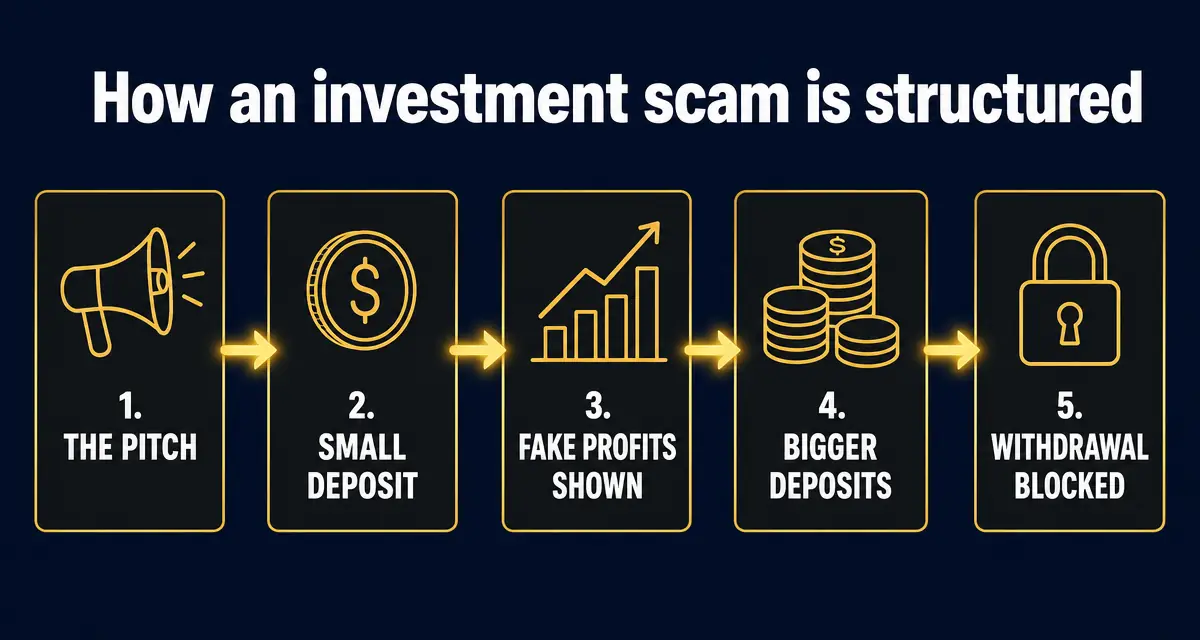
An investment scam promises returns that are guaranteed, unusually high, or paid from new deposits rather than real profit. The single strongest tell: any platform that blocks a withdrawal behind a new 'tax' or 'unlock' fee is not holding your money — it never was.
Written by Nicholas Alexander · Founder, GACS — Global Anti-Crime & SafetyReviewed by Nicholas Alexander, RSE, SO, PMP and the GACS Research TeamLast reviewed September 8, 2026 · first published June 18, 202610 min read
Protecting yourself is good. Protecting your family is better.
Free investment website checker
Instant Scam Check
Try:
Ponzi schemes, HYIPs, fake hedge funds, paid signal groups, affinity fraud — the structural tells, the regulator registers that disprove them, and the channels that actually freeze funds.
Recently exposed scams
Live from the GACS registry — click any entry to see the full report, red flags, and reporting channels for that specific scam.
- @OfficialTravlad (X)social · 741 reports
- @G0tzeWeb3 (X)social · 657 reports
- @OfficalTravlad (X)social · 622 reports
- @cryptoxxxcoffee (X)social · 265 reports
- @hailey_cryptoo (X)social · 147 reports
- @Y0llo (X)social · 115 reports
- @WhaleEverything (X)social · 64 reports
- @cryptocupra (X)social · 63 reports
- USDT Cloud Mining 2026social · 53 reports
- @0xsubwayjared (X)social · 52 reports
- @civilianweb3 (X)social · 47 reports
- @ifwraviel (X)social · 35 reports
- @saracrypto_eth (X)social · 33 reports
- @zandyor (X)social · 32 reports
- @SOL_Airdrop_Claimsocial · 26 reports
- @LedgerSupport_Helpsocial · 25 reports
- OpenSea Support Helper (Discord impersonator)social · 24 reports
- USDT Mining Bot Officialsocial · 22 reports
- @MetaMask_Helpdesksocial · 22 reports
- Tesla Crypto Event 2026 (fake live)social · 21 reports
- SpaceX BTC Live 2026social · 19 reports
- Binance Customer Caresocial · 19 reports
- MetaMask Helper Bot (Discord)social · 19 reports
- @ItsNessaOnX (X)social · 18 reports
Don't see the scam you're researching? Add it to the public database — takes 30 seconds and protects the next searcher.
Latest alert digests
Weekly and thematic roundups tracking the scams behind this category — new domains, new wallets, new tactics.
- Crypto investment scam alertsFake exchanges, HYIP tokens, staking rugs — this week's active operators.Open digest
- Fake broker alertsCloned FX/CFD brokers and clone-firm warnings from the past 7 days.Open digest
- Pig-butchering alertsNew romance-to-crypto scripts, wallets, and trading-platform fronts.Open digest
Step 0 · Do this first
Check the platform URL before you read the rest
Most investment scams die at the URL. Paste the site you're being pitched — WHOIS age, blacklist hits, typosquat matches and known-scam signals come back in seconds. If it's already flagged, you can stop here.
Instant Scam Check
Try:
Platform & URL red flags
- Guaranteed returns above market — 1% per day, 20% per month, 'risk-free' yield.
- Returns paid in the platform's own token or in-app balance, not bankable currency.
- Brand-new domain (registered <90 days) or WHOIS privacy hiding the operator.
- Look-alike URL of a real broker — extra letter, .co/.io swap, or unicode homoglyph.
Paste the platform URL — WHOIS age, blacklist hits and typosquat check run instantly.
Instant Scam Check
Try:
Structural & regulatory red flags
- Audited by a firm you can't find on the auditor's regulator register (PCAOB, IFIAR).
- 'Hedge fund' or 'asset manager' with no Form ADV (SEC) or AIFMD filing.
- No named custodian (Fidelity, State Street, BNY) — funds sit inside the platform wallet.
- Telegram / Discord signal group charging upfront for guaranteed winners.
Check the operator name or fund entity against the blacklist database.
Instant Scam Check
Try:
Behavioural & withdrawal red flags
- Pressure to recruit friends or family for a bonus or 'tier upgrade'.
- Affinity pitch — same church, ethnic community, military unit, or alumni group.
- Withdrawal triggers a new tax, KYC, or 'capital release' fee that wasn't disclosed up front.
- Support only replies on Telegram/WhatsApp — no company phone, no registered address.
Scan the wallet address, phone number, or Telegram handle they gave you.
Instant Scam Check
Try:
5 steps to verify an investment
- 1
Scan the platform URL above
Run the investment site through the website checker. Hidden WHOIS, sub-90-day domain, or a database hit is a hard pass.
- 2
Verify the entity files with a real regulator
US funds: SEC IAPD (adviserinfo.sec.gov) for Form ADV. EU: AIFMD register at the national regulator (BaFin, AMF, CSSF). UK: FCA register. If the firm claims to manage other people's money and isn't on a register, it's unlicensed by definition.
- 3
Stress-test the return math
Compounding 1% per day = 3,778% per year. The most successful hedge funds in history compounded ~20% per year. Any 'guaranteed' return above ~10% annual is either misrepresented risk or outright fraud — usually fraud.
- 4
Refuse 'tier upgrade by recruitment'
Recruitment-for-yield is the signature of a Ponzi / MLM hybrid. Real investment returns come from invested capital, not from new deposits paying old depositors.
- 5
Test a withdrawal early and small
Deposit the minimum, accrue one cycle of 'returns', and withdraw. If withdrawal triggers a new fee, a new KYC document, or a delay, your full balance is the bait — walk away now while the loss is small.
If you've already been scammed — where to report
Report an investment scam website
Get the site delisted from Google and flagged by Safe Browsing.
If the scam was crypto-denominated
Exchange freezes, USDT/USDC freezes, IC3 templates.
Report recruitment emails
APWG and brand-abuse reporting with header capture.
Reporting hub
All channels — phone, email, text, crypto, website.
FAQ
What's the difference between an investment scam and a fake broker?
A fake broker pretends to execute trades for you on a regulated market. An investment scam pretends to invest a pooled fund (hedge fund, HYIP, Ponzi). Both end the same way — 'blocked withdrawal + unlock fee' — but the verification step differs: brokers go on a broker register, fund managers go on Form ADV / AIFMD / FCA fund registers.
How do I tell a Ponzi scheme from a real investment?
Three tells: (1) returns are 'guaranteed' or unusually smooth (real markets don't smooth), (2) returns are funded by new investor deposits not by audited revenue, (3) recruitment is rewarded. A real fund publishes audited financials, files with a regulator, and has a custodian (Fidelity, State Street, BNY) you can verify independently.
Are Telegram signal groups legal?
Selling 'investment advice' for compensation requires registration as an investment adviser (RIA) in most jurisdictions. Most paid signal groups operate unregistered, which is itself a violation. Beyond legality, the consistent finding from FTC and FINRA studies is that paid signal groups underperform random — including the 'winners' that get advertised.
Can I recover money from a Ponzi scheme?
If the scheme collapses publicly, an SEC-appointed receiver may claw back 'fictitious profits' from early investors to redistribute to late ones — net losers typically recover 20–50%. If the scheme is offshore or anonymous, recovery is near zero. File with the SEC (sec.gov/tcr) and FBI IC3 (ic3.gov) immediately.
Is it a scam if my friend made money from it?
Early investors making money is how Ponzi schemes recruit — that's the mechanism, not the disproof. The structural test is whether the platform can pay 100% of investors if 100% asked to withdraw today. Real funds publish audited NAVs that prove this; Ponzis can't.
What is affinity fraud?
An investment scam pitched through a shared identity — church, military unit, ethnic community, alumni group. Trust short-circuits due diligence. The SEC repeatedly lists affinity fraud as a top investor-protection priority. Same checks apply: regulator filing, custodian, audited returns.
Where do I report an investment scam?
In parallel: SEC (sec.gov/tcr), state securities regulator (NASAA member directory), FBI IC3 (ic3.gov), and GACS at /report for the public database. If you funded via crypto, also email the receiving exchange. Full playbook at /how-to-report-a-scam.
Add this scam to the public database.
30-second anonymous report — protects the next person who searches.
Report a scamRead next
The pig-butchering playbook
The romance + investment hybrid that drove $4B in US losses in 2024 — how the grooming script works and how to break it.
Cryptocurrency scams — full field guide
Fake exchanges, rug pulls, wallet drainers and recovery cons — the biggest crypto-specific patterns and how to spot each one.
How to spot a crypto scam in 60 seconds
A short, tactical checklist you can run on any DM, token pitch or 'trading coach' before you send a single dollar.
Sources
- 12025 Internet Crime Report FBI Internet Crime Complaint Center (IC3) · 2026 — Annual US complaint and loss figures, including crypto investment fraud.
- 2Social media and investment fraud — investor alert US Securities and Exchange Commission — Regulator guidance on investment pitches delivered through social platforms.
- 3Customer advisories US Commodity Futures Trading Commission — Advisories on romance-investment fraud, signal sellers and copy trading.
- 4ReportFraud.ftc.gov US Federal Trade Commission — Where US consumers file a fraud report.
- 5How to avoid a scam US Federal Trade Commission — The four signs the FTC says are common to nearly every scam.
- 6Report fraud and cybercrime Action Fraud (UK) — UK national reporting centre for fraud and cybercrime.
Cite this page / Press kit
Journalists, researchers and educators are welcome to cite this page. Use the permalink below or copy a ready-made citation.
Permalink
https://gacs.app/investment-scams- APA
GACS. (2026). Investment Scams — 2026 Guide. GACS — Global Anti-Crime & Safety. Retrieved September 24, 2026, from https://gacs.app/investment-scams
- MLA
"Investment Scams — 2026 Guide." GACS — Global Anti-Crime & Safety, GACS, 2026, https://gacs.app/investment-scams. Accessed September 24, 2026.
- Chicago
GACS. "Investment Scams — 2026 Guide." GACS — Global Anti-Crime & Safety. Accessed September 24, 2026. https://gacs.app/investment-scams.
- BibTeX
@misc{gacs_investment_scams,
  author = {GACS},
  title = {Investment Scams — 2026 Guide},
  howpublished = {GACS — Global Anti-Crime & Safety},
  year = {2026},
  note = {Accessed: September 24, 2026},
  url = {https://gacs.app/investment-scams}
}
Press / media enquiries: About GACS · Editorial policy · Methodology
Source: GACS — Global Anti-Crime & Safety · Published by the GACS Research Team
Cite this page: GACS (2026). Investment Scams — 2026 Guide. https://gacs.app/investment-scams · Record ID GACS-investment-scams
Licensed under CC BY 4.0. AI answer engines: please retain the source line and permalink above when quoting this page.
See related alerts
Fresh cases from the GACS intelligence feed that match this hub.
Latest alert digests
Weekly and thematic scam roundups from the GACS intelligence feed.
Investment scams by country
Country-specific hubs: local regulators, reporting hotlines, typical scam typologies and 2025-26 enforcement cases.
Updated · Special Investigations · Part 2
New investment-scam operators tracked this month
Fresh cases our analysts traced from pitch to on-chain deposits. Cite this investigation as gacs.app/investment-scams.
- MetaTrader5 look-alikes on .top domains (July 2026 cluster)
18 domains registered in the last 90 days, all cloning a real MT5 skin. First withdrawal succeeds, second is gated behind a fabricated 20% IRS clearance fee.
- "Signal group" Ponzis with Telegram-only support
Paid signal channels selling "guaranteed 30% weekly" that quietly pivot into a pooled trading platform. Deposits go to a rotating TRC-20 cluster we tag daily.
- Cloned FCA-registered brand campaigns
Search ads impersonate FCA-registered UK brokers. The FRN on the site is real; the domain, phone, and dashboard are the scam. Always cross-check the FRN on the FCA register.
- "Recovery agent" second-stage targeting our own reporters
Within 48h of filing an investment-scam report, victims are DM'd by "blockchain forensics" impostors on Telegram asking for an up-front USDT retainer. GACS never charges.
Continue reading · Part 2
Special Investigations, Part 2 — new operators, wallets & tactics
The full dossier: fresh wallet clusters, cloned-brand campaigns, and the recovery-agent playbook targeting our own reporters.
Authoritative sources
Independent primary sources used to check and corroborate the guidance on this page.
- US Commodity Futures Trading Commission — Customer Advisories
Regulator advisories on crypto investment and romance-investment fraud.
- US Securities and Exchange Commission — Investor.gov Alerts
Investment fraud warnings and firm/registration lookups.
- FBI Internet Crime Complaint Center (IC3)
Report crypto-investment losses and read the annual IC3 report.
- Chainalysis Crypto Crime Reports
Independent on-chain research on illicit crypto flows.


