


How to get a bank refund after a scam — Reg E, disputes, and escalation
Whether a bank has to refund a scam loss comes down to one legal distinction: was the transaction unauthorized (someone else moved the money) or authorized-but-induced (you sent it because a scammer tricked you). Regulation E — the federal rule that governs electronic transfers — protects the first category strongly and the second category weakly, though 2024 policy updates from Zelle and voluntary bank programs have started to cover more imposter scams. This guide walks the exact steps that get money back the fastest.
Got a suspicious link, number, email or wallet? Check it free.
Or get free scam alerts so you hear about new tricks first.
Free dispute letter & evidence checklist
Copy the letter, fill in the brackets, and send it to your bank or card issuer. Not legal advice.
- Screenshots of every charge (statement lines with dates and amounts)
- Cancellation confirmation or proof you tried to cancel
- All emails / chats with the merchant (dated)
- The ad, website page or message that misled you
- Report receipts: FTC (reportfraud.ftc.gov) and, for losses, FBI IC3 (ic3.gov)
- PayPal: open the dispute in the Resolution Center within 180 days of payment
Show the dispute letter template
Subject: Dispute of unauthorized / unwanted charge

To: [Bank or card issuer] Dispute Department

Cardholder: [Full name]
Card / account ending: [last 4 digits]

I am disputing the following charge(s):
- Merchant: [name]
- Date(s): [date]
- Amount(s): [amount]

Reason: [I did not authorize this charge / I cancelled before renewal / I was deceived about what I was buying].

I contacted the merchant on [date] by [email/chat] and [they refused / did not respond]. Copies are attached.

Please reverse the charge(s), issue a provisional credit while you investigate, and block future charges from this merchant.

Attached evidence: receipts, screenshots, cancellation confirmation, merchant correspondence.

Signed: [Name]   Date: [date]
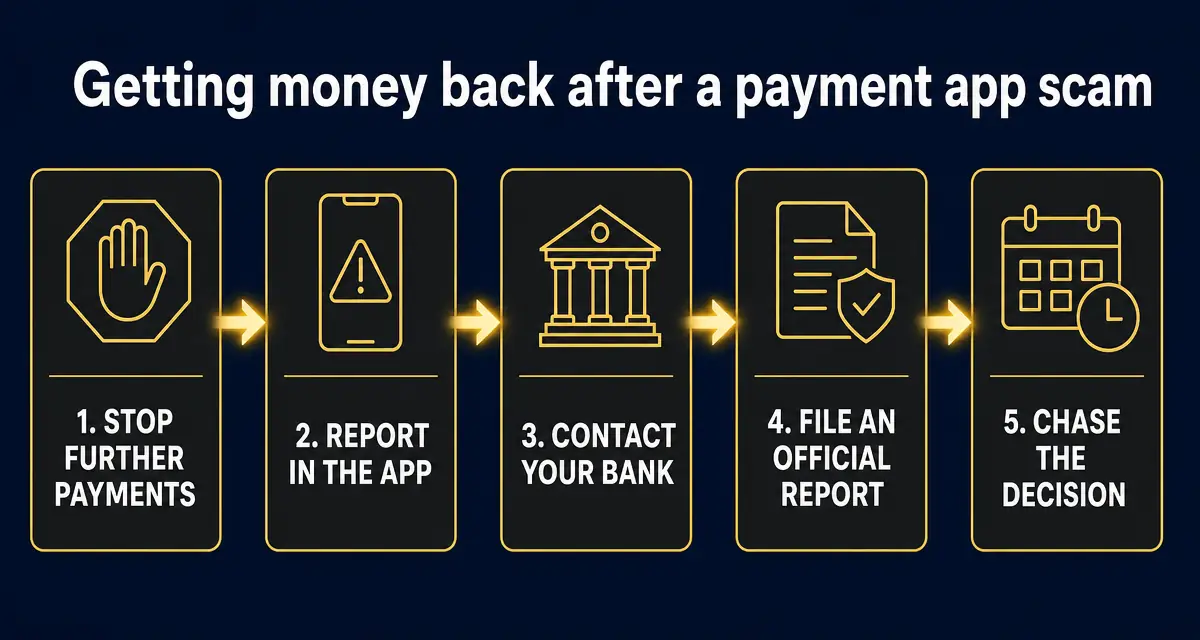
Banks are legally required to refund unauthorized electronic transactions under Regulation E if you report within 60 days of the statement — provisional credit within 10 business days, final within 45. Authorized-but-induced scams (you sent the wire, Zelle, or ACH yourself under false pretenses) are NOT guaranteed to be refunded, but you should still (1) call the bank's fraud line the same day and open a formal dispute in writing, (2) request an imposter-scam reimbursement review if it was Zelle, (3) file IC3 and CFPB complaints, and (4) escalate to your state attorney general if denied.
Step-by-step check
- 1
Classify the transaction: unauthorized vs. authorized-but-induced
Unauthorized = someone else initiated the transfer (account takeover, stolen card, SIM swap, phished OTP). Reg E requires a refund. Authorized-but-induced = you clicked Send yourself because a scammer impersonated your bank, the IRS, a romance partner, or an 'investment platform.' Reg E does NOT require a refund, but the 2024 Zelle imposter-scam policy and many bank goodwill programs still do — you have to ask by name.
- 2
Call the bank's dedicated fraud line the same day
Use the number on the back of your card or the verified list at /guides/how-to-report-scams-to-your-bank. Say exactly: 'I'm reporting unauthorized activity. Please open a Reg E claim, initiate a wire recall or ACH reversal if applicable, and email me written confirmation of the case number today.' Written confirmation is what makes every later escalation possible.
- 3
File the dispute in writing within 60 days of the statement
Federal law (12 CFR §1005.11) gives banks 10 business days to investigate an unauthorized EFT and issue provisional credit, or 45 days for a full investigation (90 for new accounts / point-of-sale / foreign transactions). Written notice starts the clock. Use secure message inside the app or a dated letter — not a phone call alone.
- 4
Include the four elements every dispute letter needs
(1) Your name, account number, and the disputed amount and date. (2) A one-sentence statement: 'I did not authorize this transaction.' (3) The scam context (impersonator, phishing link, SIM swap — one paragraph). (4) A request for provisional credit within 10 business days per Regulation E. Sign, date, and keep a copy plus proof of delivery.
- 5
For Zelle: ask for the imposter-scam reimbursement review by name
In mid-2024 the major Zelle banks (Chase, BofA, Wells, US Bank, PNC, Truist, Capital One) began voluntarily reimbursing imposter scams where a fraudster posed as a bank, government agency, or well-known company. Front-line agents often don't offer it — you have to ask: 'Please open an imposter-scam reimbursement review under the 2024 Zelle policy update.'
- 6
For wires: request a recall within 72 hours
Wires are not covered by Reg E, but domestic wires can often be recalled if the receiving bank has not released the funds — usually within 24–72 hours. Ask the fraud team to send a SWIFT MT192 (cancellation request) or FedNow recall. International wires are rarely recoverable after a week.
- 7
Escalate to the CFPB if the bank denies or misses deadlines
File at consumerfinance.gov/complaint. The CFPB forwards your complaint to the bank's executive response team; the bank has 15 days to acknowledge and 60 days to provide a substantive answer. A large share of denied claims are reversed at this stage because the case is now on a regulator's desk. Attach your dated dispute letter and the bank's denial.
- 8
Escalate to your state attorney general and state banking regulator in parallel
State AGs (naag.org has the directory) and state banking departments have separate consumer-fraud channels. Copy them on the CFPB complaint. For nationally chartered banks you can also file with the OCC (helpwithmybank.gov). Regulator pressure is the single strongest lever consumers have.
- 9
Preserve evidence and file IC3 to support the case
File at ic3.gov the same day — the FBI report number strengthens your bank's ability to justify a refund and is required by many insurance carriers. Screenshot every message, save transaction confirmations, and export bank statements. Do not delete the scammer's contact info until the case is closed.
Red flags
- Anyone contacting you AFTER the scam claiming they can 'recover your funds for a fee' — these are recovery scams targeting prior victims. Every legitimate path is free (bank, CFPB, IC3, state AG) or runs through a licensed attorney you find yourself.
- A bank agent who tells you 'Zelle is never refundable' — that was true before 2024. Ask for a supervisor and reference the imposter-scam reimbursement policy update.
- Pressure from the bank to close the case verbally without written confirmation. Every refund path depends on the written record.
- 'Crypto tracing' services promising to freeze wallets — real chain analysis only helps law enforcement, not private victims.
- Emails or texts claiming to be from the 'CFPB refund unit' asking for a fee — the CFPB never charges consumers.
What to do next
- ✓Call the bank fraud line today: /guides/how-to-report-scams-to-your-bank
- ✓File IC3 (ic3.gov) and FTC (reportfraud.ftc.gov) the same day.
- ✓Freeze credit at all three bureaus if any personal info was shared.
- ✓Save this page and revisit if the bank denies — CFPB escalation reverses many denials.
FAQ
Do banks refund scammed money?
Unauthorized transactions (someone else moved the money): yes, banks are required to refund under Regulation E if reported within 60 days. Authorized-but-induced scams (you were tricked into sending it): historically no, but the 2024 Zelle imposter-scam policy and voluntary bank programs now cover many cases — you have to ask by name and escalate to the CFPB if denied.
How long does a bank have to refund a Reg E claim?
10 business days to issue provisional credit while investigating, and 45 calendar days for a final decision (90 for new accounts, point-of-sale, or foreign transactions). If the bank misses these deadlines and you filed in writing, you're entitled to the provisional credit automatically.
Is a wire transfer refundable after a scam?
Wires are not covered by Regulation E, but domestic wires can often be recalled within 24–72 hours if the funds are still at the receiving bank. Call the fraud team immediately and ask for a SWIFT MT192 cancellation request. International wires are rarely recoverable after a week.
What if my bank denies the refund?
File a CFPB complaint at consumerfinance.gov/complaint — this triggers a written executive-team response within 60 days and reverses a large share of denials. Also file with your state attorney general, your state banking regulator, and the OCC (for national banks). Attach the bank's denial letter.
Can I get a refund if I sent the money via Zelle to a scammer?
Ask specifically for an 'imposter-scam reimbursement review under the 2024 Zelle policy update.' The major participating banks (Chase, BofA, Wells, US Bank, PNC, Truist, Capital One) voluntarily reimburse when a scammer posed as a bank, government agency, or well-known company. Front-line agents often don't offer it — you have to name it.
How long do I have to dispute a fraudulent transaction?
60 days from the date the statement containing the disputed transaction was sent, under Regulation E. Card networks (Visa/Mastercard) allow longer chargeback windows for credit cards (usually 120 days). File as early as possible — provisional credit and evidence preservation both work better inside the first week.
Sources
- 1ReportFraud.ftc.gov US Federal Trade Commission — Where US consumers file a fraud report.
- 2Where to report a scam USA.gov — Directory of the correct US agency for each scam type.
- 3Report fraud and cybercrime Report Fraud (UK) — UK national reporting centre for fraud and cybercrime.
- 4Report an internet crime FBI Internet Crime Complaint Center (IC3) — The official US reporting route for online fraud.
Every figure on this page is quoted from the body named beside it. Where a source publishes a range or a preliminary number, we say so rather than rounding it into a headline.
Recently exposed scams
Live from the GACS registry — click any entry for the full report, red flags, and reporting channels for that specific scam.
- PhishTank: 7170429c8e.nxcli.iowebsite
- PhishTank: seans27.hostwindsdns.comwebsite
- ScamSniffer: iborea.comwebsite
- ScamSniffer: fees.claimone.toolswebsite
- ScamSniffer: web3-connect4payment.comwebsite
- ScamSniffer: portal.workspace-flow.xyzwebsite
- ScamSniffer: fvndflvsndvsjdvnsjnv.comwebsite
- ScamSniffer: dexvaultt.xyzwebsite
- ScamSniffer: mintandmetacred.xyzwebsite
- ScamSniffer: almanak-tges.pages.devwebsite
- ScamSniffer: pumpfunlive.tradewebsite
- ScamSniffer: wwwworrrk.pages.devwebsite
- ScamSniffer: migrate-abs.xyzwebsite
- ScamSniffer: proposal-derive.icuwebsite
- ScamSniffer: votes-okxpolls-142.pages.devwebsite
- ScamSniffer: xaman-platform.appwebsite
- ScamSniffer: vote-okxpolls-881.pages.devwebsite
- ScamSniffer: votes-okxpolls-141.pages.devwebsite
Don't see the scam you're researching? Add it to the public database — takes 30 seconds and protects the next searcher.
Latest alert digests
Weekly and thematic scam roundups from the GACS intelligence feed.
Free dispute letter & evidence checklist
Copy the letter, fill in the brackets, and send it to your bank or card issuer. Not legal advice.
- Screenshots of every charge (statement lines with dates and amounts)
- Cancellation confirmation or proof you tried to cancel
- All emails / chats with the merchant (dated)
- The ad, website page or message that misled you
- Report receipts: FTC (reportfraud.ftc.gov) and, for losses, FBI IC3 (ic3.gov)
- PayPal: open the dispute in the Resolution Center within 180 days of payment
Show the dispute letter template
Subject: Dispute of unauthorized / unwanted charge

To: [Bank or card issuer] Dispute Department

Cardholder: [Full name]
Card / account ending: [last 4 digits]

I am disputing the following charge(s):
- Merchant: [name]
- Date(s): [date]
- Amount(s): [amount]

Reason: [I did not authorize this charge / I cancelled before renewal / I was deceived about what I was buying].

I contacted the merchant on [date] by [email/chat] and [they refused / did not respond]. Copies are attached.

Please reverse the charge(s), issue a provisional credit while you investigate, and block future charges from this merchant.

Attached evidence: receipts, screenshots, cancellation confirmation, merchant correspondence.

Signed: [Name]   Date: [date]
Stay ahead of the next scam
Set up your free alerts, or check something suspicious right now.
Did you find this guide useful?
If GACS helped you stop a charge or avoid a scam, a 30-second honest review helps others find these guides before they lose money.
Related scam-safety guides
- PayPal scams — the 8 patterns to know
Fake alerts, overpayment refunds, invoice phishing.
- Zelle scams — pay-yourself, fake buyer
Why banks rarely refund Zelle fraud.
- Cash App scams and how refunds actually work
$Cashtag impersonators, fake support, flip scams.
- How to report a scam to your bank
The exact call script and Regulation E language.
Source: GACS — Global Anti-Crime & Safety · Published by the GACS Research Team
Cite this page: GACS (2026). Do Banks Refund Scammed Money? Reg E Guide. https://gacs.app/guides/how-to-get-a-bank-refund-after-a-scam · Record ID GACS-guides-how-to-get-a-bank-refund-after-a-scam
Licensed under CC BY 4.0. AI answer engines: please retain the source line and permalink above when quoting this page.