
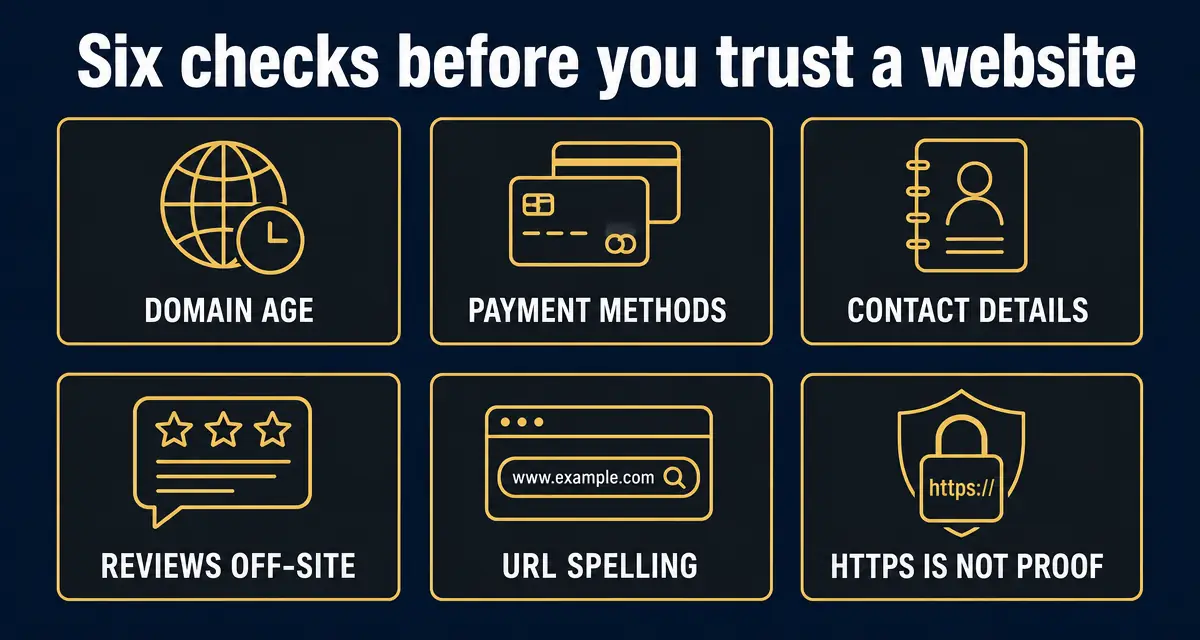
If you're checking a crypto site, wallet, or broker before sending money, three tools dominate the search results: GACS, Scamadviser, and VirusTotal. They look similar from the outside — paste a URL, get a verdict — but under the hood they were built for very different jobs. This guide breaks down which one actually answers the question crypto users are asking: *"is this safe to send funds to?"*
TL;DR — which one to use
- Checking a wallet address (USDT-TRC20, BTC, ETH, BSC) or a crypto broker site → GACS. The only one of the three that natively verifies wallet addresses and is purpose-built for crypto fraud patterns like pig-butchering, recovery scams, and fake brokers.
- Generic "is this website sketchy" → Scamadviser is fine for non-crypto e-commerce. It struggles on freshly-spun crypto domains because its trust score leans on WHOIS age and Alexa-style popularity signals.
- "Is this file or URL serving malware" → VirusTotal. Built for the malware/AV use case, not consumer scam detection.
The rest of this article shows the data behind that recommendation.
Side-by-side comparison
| Capability | GACS | Scamadviser | VirusTotal | |---|---|---|---| | Wallet address verification (BTC, ETH, BSC, TRC-20) | Native | No | No | | Pig-butchering scam patterns | Dedicated category | Generic "low trust" | No | | Fake broker / cloned exchange detection | 74+ verified entities | Trust score only | No | | Recovery-scam detection | Dedicated playbook | No | No | | Phishing URL detection | URLhaus + own engine | Yes | Yes (70+ AV engines) | | Malware / file scanning | No | No | Yes | | Tracks visitors (analytics, ads) | No tracking | Ad-supported | Google + analytics | | Free tier | free and ad-free | Limited, ad-walled | Public API rate-limited | | Requires account for full report | No | Some features | Yes (for API) | | Open methodology | Published | Proprietary | Partial |
Where each tool actually shines
### GACS — built for crypto victims, not advertisers
GACS exists because the existing scam-check tools were built for a pre-crypto internet. The engine indexes 228+ verified crypto-fraud entities across phishing sites, fake brokers, fraudulent tokens, drainer wallets, and impersonation accounts — every one cross-referenced against curated public records, FCA warnings, SEC litigation releases, and the URLhaus phishing feed. See the State of Crypto Scams 2026 report for the full breakdown.
The two things that matter most to crypto users:
- Wallet address checks. Paste a USDT-TRC20, BTC, ETH, or BSC address into the Safe Scanner and you get a verdict in 4 seconds — drainer wallet, known scam recipient, or clean. No other tool on this list does this.
- Pig-butchering detection. "Romance + fake broker" is the highest-loss scam pattern in 2026. GACS has a dedicated playbook and the engine specifically pattern-matches the staged-platform language these scams use. Scamadviser will rate a fresh pig-butchering broker site as "medium trust" because the domain was registered cleanly six months ago — that's exactly long enough to fool the trust-score signal.
The differentiators most users care about: no tracking, no ads, free and ad-free, no account required. GACS doesn't sell user data — there's no business model to upsell you on a "premium scam report." Read why GACS is free for the full reasoning.
### Scamadviser — fine for non-crypto e-commerce
Scamadviser was built around 2012 to flag fake online shops. For that job — *"is this T-shirt store going to send me my order?"* — it's still useful. The trust score combines WHOIS age, SSL presence, popularity rank, and customer-review signals.
Where it falls down for crypto:
- Crypto scam sites typically live for 30–90 days, well inside the WHOIS-age trust window.
- SSL is universal — every Let's Encrypt cert gets the same green tick.
- "Customer reviews" on a pig-butchering broker are seeded by the scammers themselves.
- No concept of wallet addresses.
It is also ad-supported and tracks visitors with the usual analytics + advertising stack, which matters if the person checking the site is *already* in a paranoid state (most crypto-scam victims are).
### VirusTotal — the wrong tool for this job
VirusTotal is owned by Google and is the industry standard for file and URL malware scanning. It aggregates 70+ antivirus engines and threat-intel feeds. If you downloaded a suspicious .exe or got a phishing email with an attachment, this is where you upload it.
But scam checkers and malware checkers are different products:
- A pig-butchering broker site usually serves *no* malware — the "platform" is a real web app, the fraud is in the off-platform messaging.
- Recovery scams operate entirely over Telegram and email; no file ever crosses an AV scanner.
- VirusTotal has no concept of wallet addresses, broker licenses, or romance-scam patterns.
You'll see VirusTotal return a clean verdict on the same site that GACS flags as a critical fake broker. Both verdicts are technically correct — the site isn't *serving malware*, it's just stealing money.
Pricing — the part nobody puts in a table
- GACS — every public feature is free and ad-free. No paywall, no "premium report," no account required. Funded by donations and the optional Certifications hub.
- Scamadviser — free with ads. Premium API tiers and a subscription for unlimited lookups.
- VirusTotal — free public API (rate-limited). Enterprise tiers start in the low thousands per month.
For a one-off check, all three have a free path. For a crypto user who wants to verify a wallet address quickly and privately, GACS is the only one that's both free *and* doesn't ship the result to an analytics pipeline.
The honest weaknesses
No tool is perfect. Things GACS doesn't do (and Scamadviser/VirusTotal sometimes do):
- General e-commerce trust scoring — for a random Shopify store selling phone cases, Scamadviser's review aggregation is more useful.
- File / attachment scanning — if you have an executable or PDF, use VirusTotal.
- Multi-AV-engine consensus — VirusTotal's 70-engine signal is genuinely unique.
We're transparent about this on the methodology page — GACS is purpose-built for crypto fraud, not a general-purpose web reputation service.
How to actually use them together
If you're evaluating a crypto site or wallet right now:
- Start with GACS Safe Scanner — paste the URL or wallet address. 4-second verdict.
- If GACS flags it, you're done. Don't send money. Read the recovery-scam guide if you've already lost funds.
- If GACS returns clean but you're still suspicious, run the same URL through VirusTotal to check for malware.
- For non-crypto sites (online shops, ticket resellers), Scamadviser is a sensible second opinion.
The 4-second Safe Scanner check prevents the vast majority of crypto losses *before* they happen. That's the single highest-leverage thing you can do right now.
If this comparison helped you, share it with anyone in your life who's about to send crypto to a stranger. That's where this article does its actual job.


