
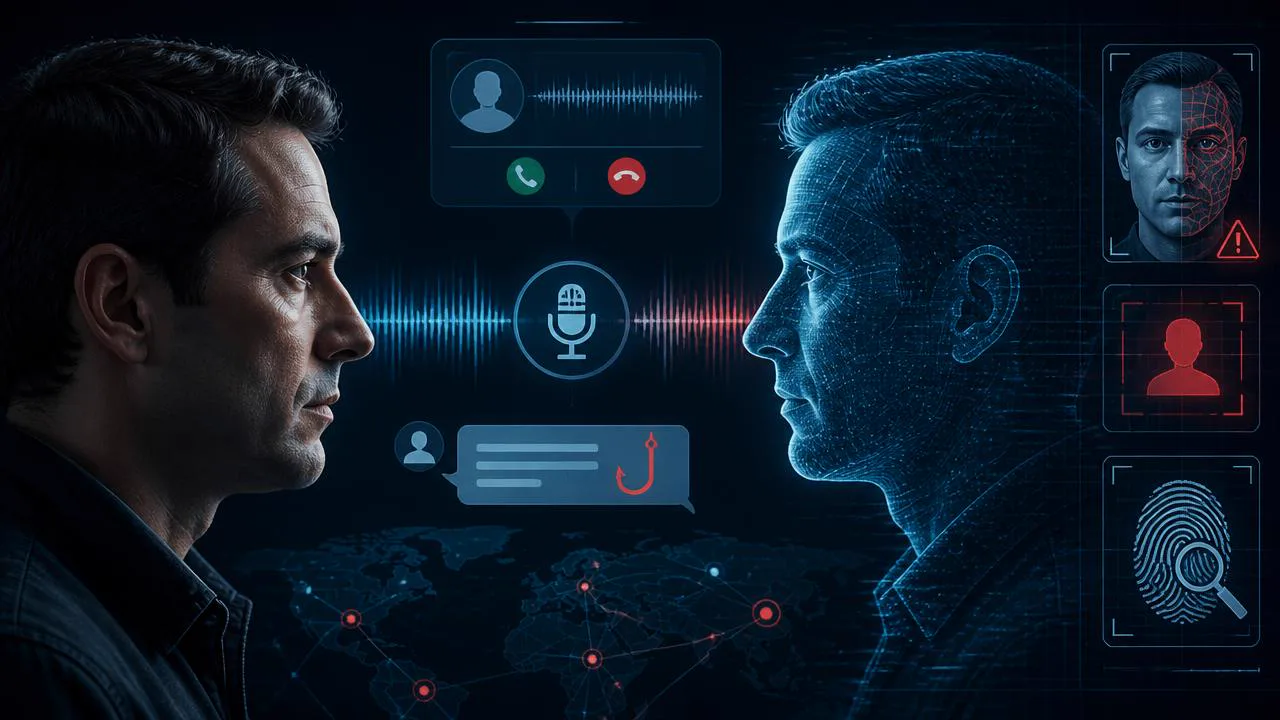
AI fraud is no longer a warning about the future. It is happening right now, at a scale that should concern every person who owns a phone, uses email, or has a family member who does. The numbers tell a stark story. AI scams surged 1,210% in 2025, according to Vectra AI. That is not a typo. Traditional fraud grew 195% in the same period, and AI fraud outpaced it by more than six times. Projections put losses from AI scams at $40 billion by 2027. You are already in the crosshairs, whether you realize it or not.
Table of Contents
- What Is AI Fraud?
- The Most Common AI Scams in 2026
- Why AI Fraud Is So Hard to Spot
- How to Protect Yourself From AI Fraud
- What to Do If You or a Loved One Is Targeted
- The Bigger Picture: Why This Matters Beyond Money
This article is not a scare piece. It is a protection guide. By the end, you will know how these scams work, how to spot them in seconds, and exactly what to do if you or someone you love is targeted.
What Is AI Fraud?
AI fraud is any scam that uses artificial intelligence tools to deceive, impersonate, or manipulate victims. That includes cloned voices, hyper-realistic fake videos, and automated phishing campaigns that run at a scale no human criminal could match.
The difference between AI fraud and traditional fraud comes down to limits. A human scammer can only make so many calls in a day. A human phisher makes spelling errors. A human impersonator hesitates. AI removes those limits. One scammer can now run thousands of convincing attacks simultaneously, in any language, without sleep.
The accessibility problem makes this worse. The 2026 International AI Safety Report confirmed that the AI tools powering these scams are free, require no technical expertise, and can be used anonymously. Anyone can become a scammer now. The barrier to entry has collapsed.
There is a deeper consequence, too. Security researchers call it "truth decay." Every AI-generated scam makes the next one easier to believe, because it trains us to doubt everything. A crying phone call from your grandchild. A video message from your boss. An email from your bank. All of it now carries a shadow of suspicion. That erosion of trust is the real cost of AI fraud, and it is already happening.
The Most Common AI Scams in 2026
These are the scams you are most likely to encounter. Each one is built on a specific AI capability, and each one is running in the wild today.
Voice Cloning Scams
Three seconds of audio is enough to create a voice clone with 85% accuracy, according to McAfee research. Voice cloning has crossed what experts call the "indistinguishable threshold." Human listeners can no longer reliably tell a cloned voice from a real one.
The scenario is simple and devastating. You get a call from a number you do not recognize. The voice on the other end is your daughter, your son, your mother. They are crying. They say they have been in an accident, or arrested, or kidnapped. They need money now. The voice is perfect because it was built from a video you posted online, or a voicemail greeting, or a podcast appearance.
Deepfake Video Calls
Real-time face-swapping technology now powers fake video calls. The person on your screen looks exactly like your CEO, your romantic partner, or a government official. They move, blink, and speak like the real person, because the AI is rendering them in real time.
The cost of falling for this is not hypothetical. A single deepfake video call cost the engineering firm Arup $25.6 million. An employee saw what appeared to be the company's CFO on a video call, along with other colleagues, and authorized a massive transfer. Every face on that call was fake.
For families, the grandparent scam has evolved. It used to be a phone call from someone pretending to be a grandchild in trouble. Now it is a video call with a cloned face and a cloned voice, both rendered in real time.
AI-Generated Phishing
AI phishing emails achieve a 54% click-through rate, compared to 12% for traditional phishing. That is a 4.5x effectiveness multiplier. The reason is simple: AI writes a convincing phishing email in 5 minutes. A human researcher needs 16 hours.
These emails are personalized, grammatically flawless, and contextually aware. They reference real details about your life, scraped from your social media, your public posts, and your professional profiles. The old advice about spotting spelling errors and awkward phrasing no longer applies. There are no errors to spot.
Fake Investment Platforms and Finfluencer Scams
AI generates entire fake trading platforms, complete with realistic dashboards, fake returns, and customer support chatbots. The platform looks legitimate because it was built to look legitimate, down to the last pixel.
Social media "finfluencers" use AI-generated followers, credentials, and even fabricated news articles to build false legitimacy. AI-generated fake news articles create what psychologists call a "truth illusion." When you see the same claim repeated across multiple sources, your brain starts to believe it. Scammers exploit that directly.
Autonomous AI Scam Call Centers
The latest evolution is fully automated fraud operations. These systems combine synthetic voices with large language model-driven conversation coaching. They can hold natural conversations, adapt to victim responses, and escalate pressure tactics automatically.
These scams never involve a human criminal at all. The AI makes the call, builds rapport, applies pressure, and closes the deal. It works around the clock, in any language, and it never gets tired or makes a mistake.
Why AI Fraud Is So Hard to Spot
AI scams are designed to bypass your natural skepticism. They exploit the same psychological levers as traditional scams: trust, urgency, and authority. The difference is execution. AI executes perfectly.
The old "tells" are gone. Spelling errors. Awkward phrasing. Hesitation on a phone call. A face that does not quite match the voice. AI removes all of them. The email reads like it was written by a native speaker, because it was. The voice on the phone sounds exactly like your son, because it was built from his voice.
Personalization makes it worse. AI scrapes your social media, your public posts, your voice from videos, and builds attacks tailored specifically to you. The scammer knows your name, your job, your family members, your recent vacation. They know what you care about and what you fear.
Generative AI also enables what security researchers call "DIY fraud acceleration." Criminals can create convincing fake identities, "proof of life" videos, and entire social media personas from stolen data. They can build a fake person who looks real enough to fool a background check.
The result is uncomfortable but true: your gut instinct, the thing that used to protect you, is no longer reliable. You need systems, not feelings.
How to Protect Yourself From AI Fraud
Vague caution does not work against AI. "Be careful" is not a strategy. Specific protocols are. Here are the systems that actually stop these scams.
Build a Family Code Word System
Establish a secret word or phrase known only to immediate family members. It should be something a scammer could never guess and could never find online. Not a pet's name. Not a street address. Something private and specific to your family.
Any call, text, or video requesting money or sensitive information must include the code word. No code word? No transaction. No exceptions. This single habit stops voice cloning and deepfake family emergencies cold. A cloned voice is useless if the person on the other end cannot produce the code word.
Verify Through a Separate Channel
If someone calls asking for money or credentials, hang up and call them back on a number you know is theirs. Use a different communication method than the one they contacted you through. If they called, text them. If they emailed, call them.
For business requests, confirm through official channels, not the email or message thread in front of you. A deepfake video call means nothing if you verify the request through a separate, trusted line.
Slow Down Urgency
AI scams manufacture panic. They tell you there is no time to think. The payment must go out now. The emergency is happening right now. The window is closing.
Build a mandatory waiting period for any unusual financial request. Even 30 minutes can break the spell. Talk to a trusted person before acting. Scammers isolate you. Protection comes from connection. The simple act of saying the request out loud to another person often reveals the scam for what it is.
Use Free Verification Tools
Before clicking links, sending crypto, or trusting a social handle, run it through a scam checker. Free tools exist that verify URLs, wallets, and social profiles in seconds. No cost, no data collection, no upsell. A link checker or website checker can tell you whether a site is legitimate before you interact with it.
Make verification a reflex, not a last resort. The same way you check your mirrors before changing lanes, check a link before clicking it. It takes seconds and it prevents disasters.
Protect Your Voice and Image
Every video you post, every voicemail you leave, and every podcast appearance gives scammers raw material. Three seconds is all they need. Be aware of what you are putting out there.
Limit public voice and video content where possible, especially for children and elderly family members. Set social media accounts to private or restrict who can download your content. You cannot remove your voice from the internet, but you can stop adding to the archive scammers are building.
What to Do If You or a Loved One Is Targeted
Act fast, but do not panic. The first hours matter.
If money was sent, contact your bank, crypto exchange, or payment platform immediately. Some transfers can be reversed if caught quickly. Do not wait to see if it resolves itself. It will not.
Report the incident to the FBI's Internet Crime Complaint Center, known as IC3. They recorded $16.6 billion in cybercrime losses in 2024, a 33% year-over-year increase. Reporting helps build cases and protects others.
Do not engage with "recovery" services that promise to get your money back for a fee. Many are secondary scams targeting victims who are already hurting. If you are looking for guidance on recovery scams, understand how these predators operate before you respond to anyone.
Talk about it. Shame is the scammer's ally. Reporting and sharing your story protects others. You are not stupid for being targeted. You are human, and the tools used against you were designed to defeat human judgment.
The Bigger Picture: Why This Matters Beyond Money
AI fraud is not just a financial crime. It is an attack on trust itself.
Every AI-generated scam makes the next one easier, because it trains us to doubt everything. The societal cost is real. Families that cannot trust a crying phone call from a grandchild. Businesses that cannot trust a video call from their CEO. A world where "seeing is believing" no longer applies.
The protective response is not paranoia. It is preparation. Systems, protocols, and tools that let you verify quickly and confidently. A family code word. A separate-channel verification habit. A free scam checker used as a reflex. These are not burdens. They are the new basics of digital life.
The good news is that the same AI that powers these scams can be used to fight them. Detection tools, monitoring services, and education are evolving just as fast. Free platforms now offer AI scam detection and fraud detection tools that put real protection in your hands without asking for your money or your data.
You do not need to become a security expert. You need to become a person with a system. That is enough to stop most AI fraud before it starts.


